News   Dec 16, 2025
 132     0 
News   Dec 16, 2025
 311     0 
News   Dec 16, 2025
 2K     7 

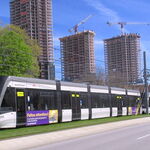
Toronto Eglinton Line 5 | ?m | ?s | Metrolinx | Arcadis

Opening days are over-rated. No one remembers what happened on the Line 1 or Line 2 opening days, decades later, they just ride it and are glad that they are there.
This is exactly how I'm going to feel once the Hurontario LRT opens. Not one for crowds, just glad that it's there.
 
I hope you are right about terminus dwell time, and wrong for the other stuff. I heard 21 minutes for the underground and above ground portion for a total of 42 minutes moving from @smallspy , who seems quite reputable. I guess that was Crosslinx or Metrolinx operating the line at that point? I don't know 100% who exactly is operating Line 5 to get 49 minutes now, but I assume it's the TTC.

If you're splitting the time for below and above ground sections at 24 and 25 minutes, instead of 21 minutes and 28 minutes respectively, then there would be less potential time savings by implementing better operations, TSP etc... on the above ground section. I fail to see how they could squeeze significant time savings, if any, out of the ATC underground section. Assuming we can only squeeze 8 minutes out of the above ground section, since the original above ground time was supposed to be ~17 minutes, then the realistic end-to-end time after potential Q1 2026 fixes would be 41 minutes. That's still slower than the 38 minutes spoken about for years by Metrolinx.

EDIT: forgot to say, L6 Finch West currently averages closer to 11-13 km/h, not 13-15. Which relates to my prediction that the Eglinton surface section will take 28 minutes at least for 7.7km.

Not an expert, but based on Finch, I see the most likely scenario as being limited improvements before launch, and bunching on the above ground impacting operations below ground. Many trains are forced to short turn. Public outrage similar to Finch but a much larger level. I hope I'm wrong.
 
I hope you are right about terminus dwell time, and wrong for the other stuff. I heard 21 minutes for the underground and above ground portion for a total of 42 minutes moving from @smallspy , who seems quite reputable. I guess that was Crosslinx or Metrolinx operating the line at that point? I don't know 100% who exactly is operating Line 5 to get 49 minutes now, but I assume it's the TTC.

If you're splitting the time for below and above ground sections at 24 and 25 minutes, instead of 21 minutes and 28 minutes respectively, then there would be less potential time savings by implementing better operations, TSP etc... on the above ground section. I fail to see how they could squeeze significant time savings, if any, out of the ATC underground section. Assuming we can only squeeze 8 minutes out of the above ground section, since the original above ground time was supposed to be ~17 minutes, then the realistic end-to-end time after potential Q1 2026 fixes would be 41 minutes. That's still slower than the 38 minutes spoken about for years by Metrolinx.

EDIT: forgot to say, L6 Finch West currently averages closer to 11-13 km/h, not 13-15. Which relates to my prediction that the Eglinton surface section will take 28 minutes at least for 7.7km.
This math makes sense as well - I would be surprised if the TTC is operating even in the ATC portion at the same time Metrolinx predicted though. Part of Finch's problem is that the TTC operates the line too conservatively - something that, like how it has bled into subway operations over the last decade, will bleed into the TTCs operation of the line even underground.

Part of the problem is TSP, a lot of it is the TTCs recent trend of operational mismanagement with 0 emphasis on travel times. Any marginal safety or maintenance improvement that can be achieved, including anything that increases travel time, is what is optioned right now in the TTC across their operational portfolio. I'm hopeful that Finch is the "straw that broke the camels back" on this issue that leads to changes in the TTC's management of their services, because their operational practices have led to significantly slower service across their network over the last decade. It's been most noticeable in their Streetcar network, but the subway network also suffers from it (most notably including the slow zones, something almost unheard of in the organization only a few short years ago).
 
Why does round trip time matter including recovery time at the terminus? Normal travel is going to be from point A to point B without the passenger waiting at the terminus to go back. And even if you were starting at a terminus, or needed to turn around and go back the other way for some reason, wouldn't there likely already be another train that would be ready to leave sooner that you could simply board and avoid the waiting time?
Let me break this down again, because something clearly got lost in translation. 90 minutes was in the original contract for total round trip (for a train operator) as @innsertnamehere kindly reminded me. That lines up with the long advertised 38 minute end-to-end one way trip in this way: 90-38-38=14 minutes. This extra 14 minutes they deduced was the recovery time, which you could interpret as 7 minutes at each terminus after the end of each one way trip. From another perspective, this would instead be the time spent before the start of the next one way trip going back the other way. When we apply this understanding to the new 112 minute round trip (for the train operator), we get a round trip time of 98 minutes for the transit rider. 112-14=98. One way trips would then be 49 minutes, half of 98. You appear not to understand that even if you wanted to, you would not be able to ride the line any faster than that time theoretically, because the train would not leave the terminus station. The recovery time is there to maintain headways/consistent frequencies and reduce the effect of delays leading to bunching. This is why the recovery time at each terminus is longer than the scheduled headway time. You are right, on some transit lines, this allows for one train to always be ready at the terminus platform to take on outbound passengers, while the inbound train that just ended their revenue trip loops around non-revenue track beyond the terminus station platform.

Further evidence:
When you look at the subway scheduled "run time" on page 5/62 of the recent TTC Service Summary, you will see a number that is more than twice the time it takes for a trip from the Vaughan Metropolitan Centre to Finch or vice versa (Vaughan to Finch and Finch to Vaughan take slightly different times, but for the sake of the argument let's just pretend they're the exact same). That is because there is recovery time at the terminuses. For example, Line 1 "Monday-Friday morning peak period" it lists a "run time" of 158 minutes, which is significantly more than the 146-150 minute scheduled round trip for a passenger. The scheduled round trip experienced by passengers is timed from the moment the train leaves the starting terminus to opening the doors at the end terminus. Now those are all scheduled and theoretical; actual trip times are virtually always longer, with reduced speed zones etc...

Any TTC staff, subway experts etc... feel free to correct me if I am wrong.

https://www.ttc.ca/transparency-and-accountability/transit-planning
- Myers: what is the estimated run time for Line 5. TTC staff: contractual number for round trip time is 98 minutes during rush hour and 90 minutes outside rush hour
- The current schedule we have for RSD is currently scheduling 112 minutes round trip
EDIT: How is this post being liked after this reply, do people not understand 112 - 14 = 98??? Noone is saying a round trip for a passenger will take 112 minutes. Beggars belief.
1765470028710.png
 
Last edited:

“We’re going to work with the TTC on this, but this is with the TTC now,” Sarkaria told Global News. “When the TTC feels comfortable to move forward, they will do so on an operational basis.”

---

"Comfortable" apparently meant Feb 8 on Dec 5. Now that the TTC has seen the reception Line 6 has received, I wonder what date "comfortable" means now
 
There's a bunch of threads where this could go but I'll stick it here. Member's motion from The Mayor going to council next week
Speeding Up Light Rail Transit and Streetcars - by Mayor Olivia Chow

1. City Council direct the City Manager, working with Metrolinx and the Chief Executive Officer, Toronto Transit Commission, to advance implementation of more aggressive, active transit signal priority at intersections along surface portions of the Line 5 Eglinton and Line 6 Finch West, subject to contractual and legal obligations, and to provide an update on progress in the first quarter of 2026.

2. City Council direct the City Manager, working with the Chief Executive Officer, Toronto Transit Commission, to report back in the first quarter of 2026 with a plan, including costs and staffing requirements, to implement further measures that improve streetcar network speed and reliability, including signal timing adjustments, a more aggressive transit signal priority policy, deploying traffic agents at key intersections to prevent blocked streetcars, and recommendations for removing on-street parking and restricting left turns during high-peak periods on key streetcar routes.

3. City Council direct the City Manager, working with the Chief Executive Officer, Toronto Transit Commission, to report back in the first quarter of 2026 with a plan, including costs and staffing requirements, to expedite transit signal priority activations at intersections on the surface transit network where the required technology is not currently installed.

 
There's a bunch of threads where this could go but I'll stick it here. Member's motion from The Mayor going to council next week
Speeding Up Light Rail Transit and Streetcars - by Mayor Olivia Chow

1. City Council direct the City Manager, working with Metrolinx and the Chief Executive Officer, Toronto Transit Commission, to advance implementation of more aggressive, active transit signal priority at intersections along surface portions of the Line 5 Eglinton and Line 6 Finch West, subject to contractual and legal obligations, and to provide an update on progress in the first quarter of 2026.

2. City Council direct the City Manager, working with the Chief Executive Officer, Toronto Transit Commission, to report back in the first quarter of 2026 with a plan, including costs and staffing requirements, to implement further measures that improve streetcar network speed and reliability, including signal timing adjustments, a more aggressive transit signal priority policy, deploying traffic agents at key intersections to prevent blocked streetcars, and recommendations for removing on-street parking and restricting left turns during high-peak periods on key streetcar routes.

3. City Council direct the City Manager, working with the Chief Executive Officer, Toronto Transit Commission, to report back in the first quarter of 2026 with a plan, including costs and staffing requirements, to expedite transit signal priority activations at intersections on the surface transit network where the required technology is not currently installed.

That's a very City of Toronto - we will request a plan/staff report (from the very people/organization who oversaw this debacle). In this town, it's meaningless - the true measure of progress is actual outcome, not what's on a piece of paper.

And in case this isn't cynical enough, wait till you see the amendments after the round of inevitable speechmaking by the councillors.

AoD
 
Last edited:
Line 4 was always roughly geographically correct to Line 2. It's really Line 5 (a new addition to the map) and the eastern end of Line 2 that messes it up. And they probably didn't even think to fix that.
Fix? It's not a geographic map. If they did it geographically, you wouldn't be able to read the names.

I've never seen a to scale map on a train. It's not the same distance between King and Queen as Lawrence and York Mills. I don't think fixing that discrepancy is what people want.
 
"Comfortable" apparently meant Feb 8 on Dec 5. Now that the TTC has seen the reception Line 6 has received, I wonder what date "comfortable" means now

The TTC couldn't give two shits about line reception. Thats the problem. They have zero care or understanding of optics or marketing or anything. All they care about are their employees and appeasing the union. Eglinton will 100% open just as slow as Finch, even if the TTC is forced to speed up Finch. They will learn nothing.
 
They have zero care or understanding of optics or marketing or anything. All they care about are their employees and appeasing the union.
[citation needed]

If this were the case, then you wouldn't have people jumping ship from streetcar en masse due to the micromanagement and politics.
 
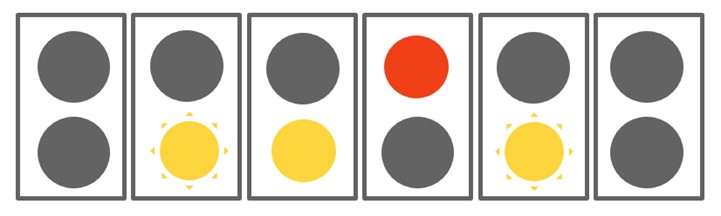
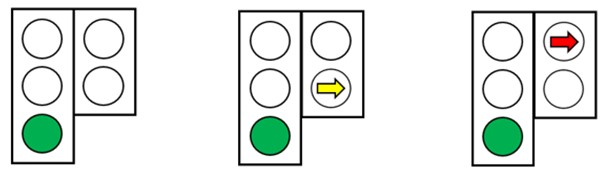
I knew these LRT lines were awry when we didn't adopt four-aspect signals:
We suck when we can't even figure transit signals out...

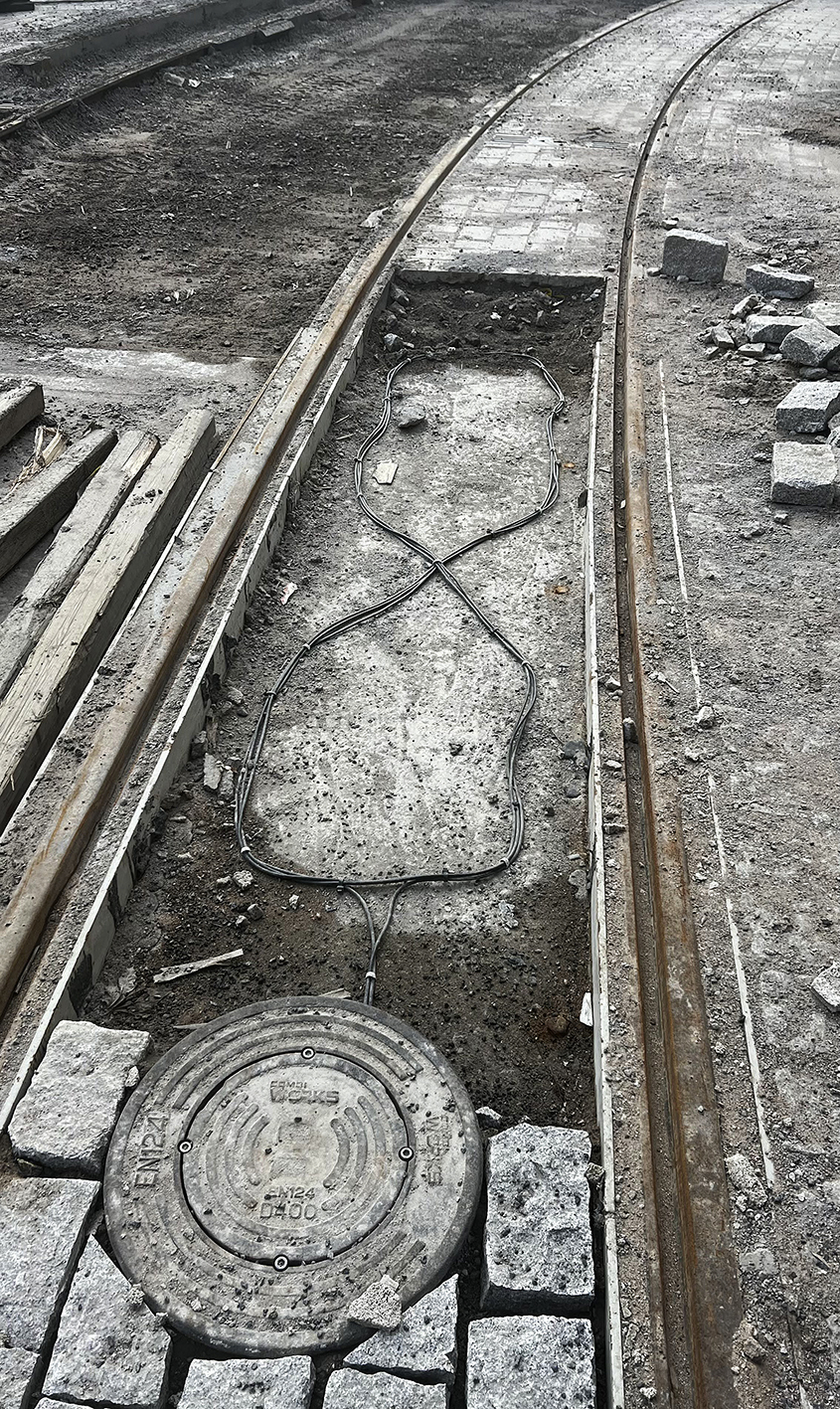
Thought I'd start out with a beautiful photo of a "loop detector"/Induction loop (Wiki):
silmukka.jpg

(Helsinki)

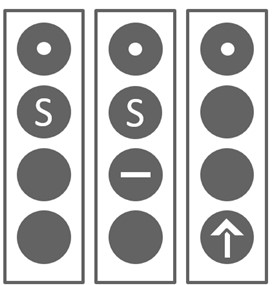
If Lines 5/6 were meant to be anything other than streetcar lines in the open sections, we should've had four-aspect transit signals...

Finland adapted the Germans:
View attachment 654012F4
4-aukkoinen-raitiovaunuopastin.jpg

This is only where full priority exists, eg. how Toronto intersections are fully signalized.

Operators are given the ball to provide eight-seconds notice that they've been acknowledged, before the five-second red-yellow phase. They're provided with ~13-seconds notice to adjust their speed before the signal changes to green.

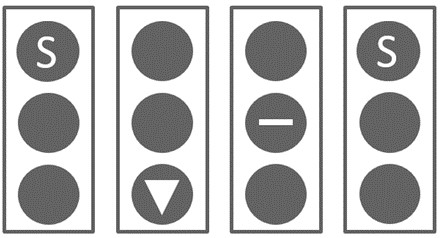
Otherwise you have these, when conflicting interactions are given a cautionary yield.
View attachment 654015F5
Raitiovaunun-info-opastin.jpg

They are usually accompanied by these:

2-aukkoisen-punakeltaisen-liikennevalon-sekvenssit.jpg

At roundabouts;

2-aukkoinen-punakeltainen-nuoliopastin.jpg

At right-turns - Left-turns are always protected.

Good video (in German)
K-W has the flashing stop bar indicating that the signal is about to change to green.

On Helsinki's Line 15, tram operators are afforded ~13 seconds notice at 70km/h (8 seconds with German F4, 5 seconds with red/yellow combo).

I found it interesting that it was said at the most recent TTC meeting that the loop detectors should be moved back.

I've said it before they could mitigate the four-aspect by having a red-yellow phase.

The fact that Steve Munro said the TTC hasn't even explore what K-W has done is pathetic...
 

Back
Top