News   Feb 23, 2026
 305     0 
News   Feb 23, 2026
 470     1 
News   Feb 20, 2026
 1.1K     0 

TTC: Streetcar Network

Somewhere I saw a TTC diagram highlighting the locations of the tightest curves but I can't find it right now. If anyone else knows where it is, that would be much appreciated.
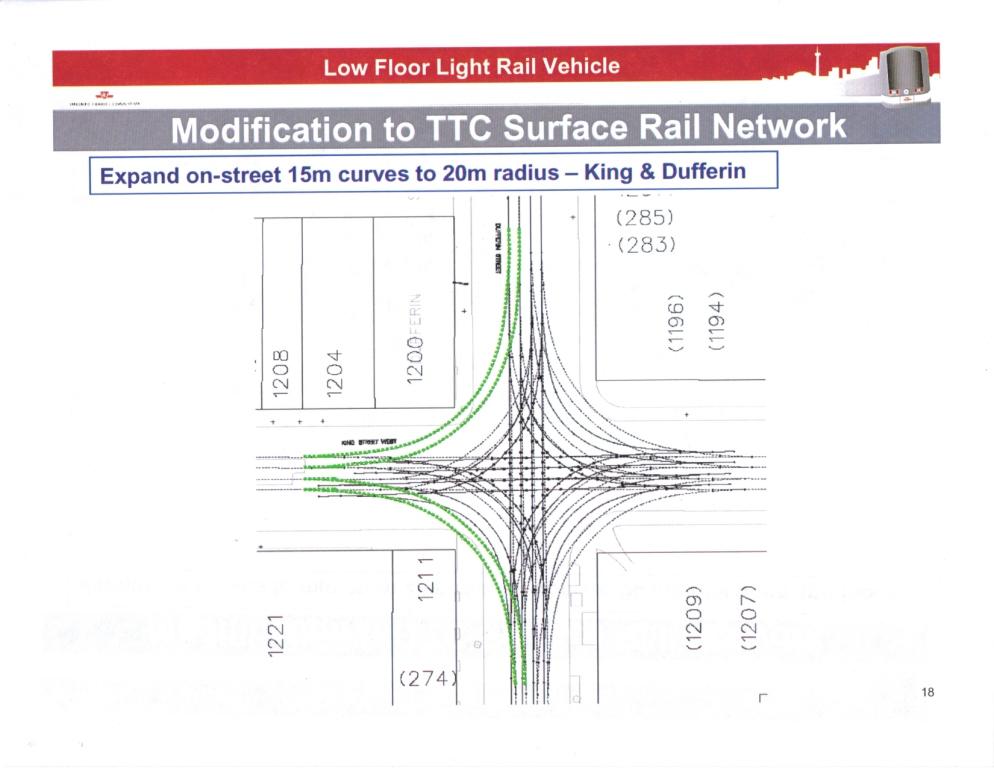
Steve Munro has an old blog post from 2008 with this diagram from a TTC presentation.

Screenshot 2026-02-18 at 7.37.09 PM.png
 
Thanks! Turns out it was a 20-metre radius they were looking at, not 25, but that's still obviously silly. They show that they can't increase the radius from 15 metres to 20 at King & Dufferin, but that misses the point that 15 metres is already far better than the 11-metre radius found in a handful of other places on the network. The question isn't whether we can increase the radius at King & Dufferin, it's whether we can bring other corners up to the radius we already have at King & Dufferin. Steve mentions in the comments that Basel has a minimum radius of 11.8 metres, Boston has a minimum of 13.5 m and Melbourne has a minimum of 15 m. Getting up to those slightly higher radii would presumably make it possible to use those cities' tram models with relatively little modification.
lflrv18c.jpg


In the same presentation they show this diagram, which suggests that there it might take as few as 5 curve realignments to get the minimum radius up to 12.2 metres, or 8 realigments to get it up to Boston's 13.5 metres.
Capture1.JPG


The purpose of that discussion in 2008 was related to an imminent vehicle procurement so yes of course the conclusion was that they couldn't rebuilt the network to make off-the-shelf streetcars fit. But after making that conclusion there was no plan set forth to address the infrastucture issues over the next half century for the next time we need to procure streetcars.

I also can't help but notice that the vast majority of the sub-15 curves crossed out on the map are short-turn or terminal loops that would be unnecessary with bidirectional streetcars...
 
Last edited:
I am not knowledgeable on other places, but I have never understood this weird situation where we like to buy only in huge, bulk orders, then no orders for the next x decades, and never piecemeal. It makes it much harder to have any form of industry here in Canada, because instead of a few, stable jobs, it's this huge burst of cold start manufacturing, hire & fire, then lose all the knowledge, and repeat.

I’ve always assumed it has to do with the TTC being long-starved for money; only able to buy new stock when the province or feds decide to open their wallets.
 
I am not knowledgeable on other places, but I have never understood this weird situation where we like to buy only in huge, bulk orders, then no orders for the next x decades, and never piecemeal. It makes it much harder to have any form of industry here in Canada, because instead of a few, stable jobs, it's this huge burst of cold start manufacturing, hire & fire, then lose all the knowledge, and repeat.

The shorter lifecycle, volume of bus transit, & private operators here makes it easier for buses, theyve figured it out there, but for rail...? TTC streetcar had no orders between '89 and '12, Line 2 got their rolling stock in '95 and probably be replaced by '30... What are manus supposed to do in the 35 year time between orders? Sit around?
When everything is bespoke, the fewer times you need them to engineer a solution the cheaper it will be.

If we could get more cities to build streetcars and subways to our standards, then the costs of buying new rolling stock would go down, and there would be a far greater likelihood of being able to buy in small batches of equipment, rather than these huge wholesale investments.

And that was the point of Transit City and all of the LRTs that are being built now in Ontario. Yes, they may differ in the details, but ultimately they are (almost) all being built to the same basic form factor and standard, which means that there should be a possibility to buy cars in smaller batches, and with less customization, from a greater number of manufacturers.

Dan
 
Last edited:
I'm seeing a pattern here.
Or convert into double-ended streetcars,
they could order double-ended streetcars
If the TTC went instead with double-ended streetcars
put in a order to use double-ended streetcars
If we had double-ended streetcars,
Maybe double-ended streetcars?
Not going to happen. We are never going to operate double-ended streetcars in your lifetime or mine. The single cab Flexity Outlooks and any follow-on orders from Alstom will be operating on the TTC for the next forty to fifty years, same as we did for the CLRV (1979-2019) and the PCC (1938-1995). You will never see double-ended streetcars on the TTC's streetcar network. Perhaps we'll see them on a LRT or airport shuttle in Ontario, but on Toronto’s general streetcar network? No chance.
 
Last edited:
How far ahead did the TTC decide on the modifications to routes along the Eglinton and Finch lines? The opening of a downtown subway will no doubt have an effect on the streetcar network that pass through it and duplicates it in sections. It's a complex project to manage, perhaps requiring new track and/or switches. We're 5 years away from Line 3 opening, when does that study begin being discussed? Will the community be consulted or will the TTC just make those decisions on their own?

I can't imagine the 501 comes out of this unscathed. East Harbour has no transit. The 501 could be modified to go south on Broadview instead of continue west duplicating Line 3 along Queen. Interchanges: Riverside and East Harbour (Line 3)

In the downtown portion, a King/Queen continuous loop from Spadina to Church would serve local stops. Interchanges: Queen-Yonge and Osgoode (Line 3, Line 1) and King and St. Andrew (Line 1)
Alternative: A one way downtown loop Wellington westbound from Church to York, Queen eastbound from York to Church.


The western leg terminates at Spadina station. Interchanges: Queen-Spadina (Line 3) and Spadina (Line 2)
 
Last edited:
How far ahead did the TTC decide on the modifications to routes along the Eglinton and Finch lines? The opening of a downtown subway will no doubt have an effect on the streetcar network that pass through it and duplicates it in sections. It's a complex project to manage, perhaps requiring new track and/or switches. We're 5 years away from Line 3 opening, when does that study begin being discussed? Will the community be consulted or will the TTC just make those decisions on their own?

I can't imagine the 501 comes out of this unscathed. East Harbour has no transit. The 501 could be modified to go south on Broadview instead of continue west duplicating Line 3 along Queen. Interchanges: Riverside and East Harbour (Line 3)

In the downtown portion, a King/Queen continuous loop from Spadina to Church would serve local stops. Interchanges: Queen-Yonge and Osgoode (Line 3, Line 1) and King and St. Andrew (Line 1)
Alternative: A one way downtown loop Wellington westbound from Church to York, Queen eastbound from York to Church.


The western leg terminates at Spadina station. Interchanges: Queen-Spadina (Line 3) and Spadina (Line 2)
The TTC started publicly discussing the bus route changes about 2 years before the two lines were originally anticipated to open.

But the planning process had been going on for several years prior to that They took ridership counts and tried to see there people were making connections with other routes to see if they could make those trips simpler. They also looked at traffic and congestion patterns, and how those could play in to the route structure. And in fact despite what was originally shown to the public, they ended up making a couple of additional changes above and beyond what were originally anticipated because of what they found.

No doubt that they've started the process now for the Ontario Line. But if the line isn't projected to open until 2031, then I wouldn't expect to see what the anticipated changes are for another 3 years.

And keep in mind that there's a bit of a moving target, too - who knows what the Portlands will look like at that point, or what funding may or may not have been dedicated.

Dan
 
Not going to happen. We are never going to operate double-ended streetcars in your lifetime or mine. The single cab Flexity Outlooks and any follow-on orders from Alstom will be operating on the TTC for the next forty to fifty years, same as we did for the CLRV (1979-2019) and the PCC (1938-1995). You will never see double-ended streetcars on the TTC's streetcar network. Perhaps we'll see them on a LRT or airport shuttle in Ontario, but on Toronto’s general streetcar network? No chance.
Ah yes perhaps some day we'll see double-ended streetcars on an LRT in Ontario. What a wild speculative idea.
 
The TTC started publicly discussing the bus route changes about 2 years before the two lines were originally anticipated to open.

But the planning process had been going on for several years prior to that They took ridership counts and tried to see there people were making connections with other routes to see if they could make those trips simpler. They also looked at traffic and congestion patterns, and how those could play in to the route structure. And in fact despite what was originally shown to the public, they ended up making a couple of additional changes above and beyond what were originally anticipated because of what they found.

No doubt that they've started the process now for the Ontario Line. But if the line isn't projected to open until 2031, then I wouldn't expect to see what the anticipated changes are for another 3 years.

And keep in mind that there's a bit of a moving target, too - who knows what the Portlands will look like at that point, or what funding may or may not have been dedicated.

Dan

Thanks, good additional perspective on this.

The Portlands will need transit too and perhaps that could be connected to East Harbour in some way in the future as it develops but the immediate need — and I say “immediate” because if this major transit hub opens in 5 years, they should’ve started planning transit connections 2 or 3 years ago — is to connect high capacity transit transfers to and out of this station. Buses aren’t going to be able to handle the volume without clogging up roads.

Splitting the 501 has been the topic of discussion for decades now. East Harbour to Neville Park is an ideal solution to defining its eastern leg and connecting it to the subway at 2 stations while eliminating two thirds of the opportunities for disruption of its schedule. The shorter the route, the fewer the chances at disruption.

The western leg even if it turns north at Spadina to Spadina station (connecting at Lines 3 and 2) or south to the waterfront route to Union Station, it will still remain the longest streetcar route. The 501 is stupidly long.

A downtown loop serves local stops downtown. Keeping it one way in a continuous loop, limits it to one traffic lane that could potentially be reserved while serving Queen Street stops and historic Wellington, stopping at Line 1 and Line 3 connections with a one block walk to Union Station at Wellington and Bay/York.

Streetcars in mixed traffic are terrible for long distances. There’s too much potential for getting stuck in traffic and ruining its schedule. There is never going to be political capital available to shutting downtown Queen to cars in the same way that King was because detractors will have the (good) excuse that downtown Queen is already served by subway.

So we should pivot the function of streetcars for hop on/hop off local stops and subway feeder transit arms.
 
Ah yes perhaps some day we'll see double-ended streetcars on an LRT in Ontario. What a wild speculative idea.
I actually think we're more likely to see no-ended LRTs (autonomous or remote operated, without any cabs, or drivers) in Toronto before we see LRTs with cabs at both ends. Similar to the Terminal Link train at Pearson Airport.
 
I actually think we're more likely to see no-ended LRTs (autonomous or remote operated, without any cabs, or drivers) in Toronto before we see LRTs with cabs at both ends. Similar to the Terminal Link train at Pearson Airport.

Agreed, though once most of the large-scale vehicle savings disappear [driver salary for example] I expect smaller vehicles (40 foot or even 30 foot buses) to become the only thing used. Running 3 as a bunch isn't a big deal when there aren't 3 drivers, provided the driver-as-a-service fees are sufficiently low; a virtually-coupled EMU if you will.

I'm not sure Toronto will refresh the streetcar fleet in ~2050 at a scale beyond what tourism might enable.
 
Last edited:

Back
Top