News   Dec 23, 2025
 609     3 
News   Dec 23, 2025
 1.5K     1 
News   Dec 23, 2025
 2.2K     1 

Finch West Line 6 LRT

It's truly stunning how the same gaggle of people who argued against all evidence for years took the briefest of breaks from arguing their inane points in the week after Line 6's disastrous opening.... and then immediately continued on as if nothing had changed. It's clearly useless to try and engage with people who are both incapable of integrating new information into their mind, and who treat forms of rail vehicles as a sort of idol to be uplifted....instead of a form of transportation intended to move people.
They're pushing all their chips on TPS saving the line.

They don't even want to entertain the idea of knocking down a couple stops (on top of TPS) to help speed up the line.
 
They pushing all their chips on TPS saving the line.

They don't even want to entertain the idea of knocking down a couple stops (on top of TPS) to help speed up the line.
I think I have brought up Paris T9 about two dozen times now, and not one person has explained why the larger and denser Paris has a tram line 15 km closer to downtown than Line 6 of Toronto.

Is it at all possible Line 6 was chosen because it was nominally cheaper to build, but this ill-advised prioritization over denser corridors and consequent lack of, even negative ROI was a direct consequence? If you build a tram for a comparatively less populated area, you will get less ridership, less ROI. Less social ROI, economic ROI, and standard financial ROI. You don't need a Nobel prize winning economist to tell you that.
 
You've overlooked the fact that these are NOT well outside the core in an apples to apples comparison with Toronto.
OK, fair enough. But in that case, why does it materially matter how far outside the core the corridor actually is? It's not as though density is a function of how far removed from the core the area is, there are a lot of factors.
I'm very explicitly addressing the fact that's not what he argued, but that his concern over slower car travel would be caused by the same grade conflicts that would slow LRT - NOT that he cared about that. Maybe read what I said before writing your next novel.
I read what you said very well. But despite the disclaimers you put, the entire rest of your argument is about how he got it more right than all the "experts". Your disclaimer goes against the entire rest of the content of your post, and it is very easy to see where your sympathies lie.

It's truly stunning how the same gaggle of people who argued against all evidence for years took the briefest of breaks from arguing their inane points in the week after Line 6's disastrous opening.... and then immediately continued on as if nothing had changed. It's clearly useless to try and engage with people who are both incapable of integrating new information into their mind, and who treat forms of rail vehicles as a sort of idol to be uplifted....instead of a form of transportation intended to move people.
Because operational practices can change!!!

What part of this concept is so difficult for you to understand? All the pro-LRT folks are equally dismayed at the poor early performance of the Finch LRT, and want it to do better. You, and all the other subway foamers on this forum, seem incapable of comprehending, despite thousands of messages explaining to the contrary in great detail, that slowness is NOT an inherent feature of LRTs, and that the solution to that slowness isn't to give sprawling suburbia subways, but to improve the operational speeds.

You keep arguing against a strawman that doesn't exist. I repeat: slowness is NOT an inherent feature of LRTs. Suggesting it is is intellectually on the same level as saying that subways are bad because the H6 subway cars were unreliable lemons, or that buses are bad because the same could be said of the Orion hybrids. Maybe we wouldn't have to keep trotting out the same "inane points" over and over again if you actually mounted a coherent argument against them.

N.B. I am pro-LRT because it's a cheaper option of delivering high capacity transit. In a world that has limited amounts of money, the greedy suburbanites of Toronto should not have access to all the monies for new transit projects. If that strikes you as idolatry, that's your problem and should deal with it accordingly.
 
Last edited:
Is it at all possible Line 6 was chosen because it was nominally cheaper to build,
Cheaper compared to what? A subway? I'm a very pro-subway guy, and I've never advocated for a subway along Finch. Not dense enough.

I've advocated for a BRT along Finch West. If the motivation was to build whatever is the cheapest, then they should have gone with a BRT.

People will make the "capacity" argument. But I think if you give buses their own lane, then having frequent, articulated buses would have helped to deal with capacity issues.
 
As an aside from Line 6, which I still think does not deserve a tram: If you look at comparable cities in magnitude and density, among developed and near-developed countries: Toronto has the smallest subway network. There are many cities (metro areas) smaller (less dense) than Toronto with more extensive networks. In the words of my recent immigré friend looking at Toronto's skyline:

"There really isn't any other city the size of Toronto that has such a small metro system."

A tram is a good measure for a corridor that will not grow dense enough to ever need a metro. In light of the recent record breaking cumulative growth of 15%+ in Toronto, compared to demographically stagnant tram-only Euro cities, is it really assured that Toronto will never need a metro even in areas near downtown? Ignoring the issues precluding tram expansion near downtown-ish in the first place, which are also the only places suited for trams in the first place (see Paris).
Two examples of the many problems with the concept of trams in Toronto:
The only streets in the downtown periphery that can justify new tram lines are too narrow and are arranged in a grid instead of radially. I am looking at areas with superficially similar densities as European city areas with trams (even though urban morphology is entirely different).
*except for the lakefront i.e. Waterfront LRT
 
Last edited:
What this debates gets wrong is this. Finch west needed an upgrade. So many times a bus would be full and people would need to wait for multiple buses to pass before getting on one. It's true other corridors probably needed to be looked at first but the solution is not do nothing on Finch. The solution is invest in transit. Toronto's population is approaching 3 million. It should have more subways, but also more LRT's, more elevated rail , more bus lanes, and better regional rail integrated with the TTC. The city could introduce congested pricing to raise revenue, provide aggressive transit priority for surface routes, push Ontario government to fund GO train 15 minute sevice at least for toronto proper, and encourage development along transit routes to get the highest ridership possible. It's not rocket science, it just about politicians making the right choices.
 
Toronto's population is approaching 3 million.
A nitpick, Toronto's population is at least 3.3 million as of July 1, 2024, and probably more like 3.5 million due to growth and undercounts of NPRs e.g. visa renewals.
 
What this debates gets wrong is this. Finch west needed an upgrade. So many times a bus would be full and people would need to wait for multiple buses to pass before getting on one. It's true other corridors probably needed to be looked at first but the solution is not do nothing on Finch. The solution is invest in transit. Toronto's population is approaching 3 million. It should have more subways, but also more LRT's, more elevated rail , more bus lanes, and better regional rail integrated with the TTC. The city could introduce congested pricing to raise revenue, provide aggressive transit priority for surface routes, push Ontario government to fund GO train 15 minute sevice at least for toronto proper, and encourage development along transit routes to get the highest ridership possible. It's not rocket science, it just about politicians making the right choices.
No one here is arguing against transit investments along Finch or across Toronto. Were debating over which mode of transit could have best served this corridor.
 
A nitpick, Toronto's population is at least 3.3 million as of July 1, 2024, and probably more like 3.5 million due to growth and undercounts of NPRs e.g. visa renewals.
Toronto has likely lost around 100,000 people in population in the last 12 months. The whole out-of-control TFW program pumped numbers up artificially high and it's correcting now.

Finch should have seen a "simple" 6-lane widening with curbside bus lanes and more bus service, IMO, and taken the $1.8 billion in savings and done the same for various suburban corridors across the city.
 
Toronto has likely lost around 100,000 people in population in the last 12 months. The whole out-of-control TFW program pumped numbers up artificially high and it's correcting now.

Finch should have seen a "simple" 6-lane widening with curbside bus lanes and more bus service, IMO, and taken the $1.8 billion in savings and done the same for various suburban corridors across the city.
If you're going to put bus lanes on a 6 lane stroad you may as well just go full Highway 7 and build a proper BRT down the middle of the road, with actual stops. At least then not only could you sell it as an actual upgrade to local residents but it will also be easier to convert to LRT when it inevitably reaches capacity.
 
If you're going to put bus lanes on a 6 lane stroad you may as well just go full Highway 7 and build a proper BRT down the middle of the road, with actual stops. At least then not only could you sell it as an upgrade to local residents but it will also be easier to convert to LRT when it inevitably reaches capacity.
That costs roughly double per mile and actually results in slower operations than curbside operations as you now have to deal with protected left turn movements for vehicles.

You could do curbside lanes with an actual curb protecting the bus lane mid-block if you want, opening to allow right-turning cars to use the lane at intersections, but as soon as you need to separate bus operations from general traffic it actually gets slower since you need to introduce unique signal phases.

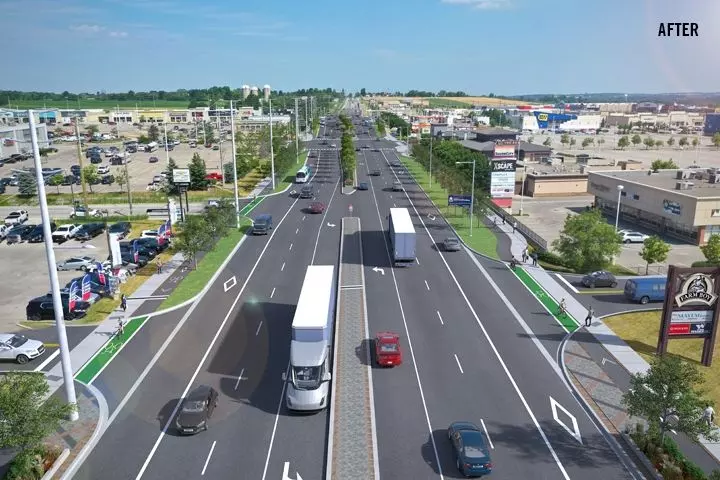
This costs half of much and has better operations and is safer for transit users than a median lane:

1766515777120.png


Full depth reconstruction with upgraded landscaping treatments for a 6-lane road costs about $50 million per kilometre. York Region is building this configuration in Newmarket right now. You could easily splurge a small bit extra to introduce higher quality bus stops with heated shelters if you wanted. The project has a budget of $94 million for 2 kilometres of reconstruction.


4_Town%20Line_Proposed-sm-after.webp
 
Last edited:
Toronto has likely lost around 100,000 people in population in the last 12 months. The whole out-of-control TFW program pumped numbers up artificially high and it's correcting now.

Finch should have seen a "simple" 6-lane widening with curbside bus lanes and more bus service, IMO, and taken the $1.8 billion in savings and done the same for various suburban corridors across the city.
I wonder if people are aware of just how much transit ridership numbers across Ontario municipalities have been inflated by TFW and International students?

Multiple cites across the GTA already reporting downward trends.
 
That costs roughly double per mile and actually results in slower operations than curbside operations as you now have to deal with protected left turn movements for vehicles.

You could do curbside lanes with an actual curb protecting the bus lane mid-block if you want, opening to allow right-turning cars to use the lane at intersections, but as soon as you need to separate bus operations from general traffic it actually gets slower since you need to introduce unique signal phases.
What? TPS exists for LRTs but not BRTs?
 
What? TPS exists for LRTs but not BRTs?
Oh it does, but if the City can't make it work for an LRT do you have any hope of it happening on a BRT?
 

Back
Top