News   Dec 05, 2025
 292     0 
News   Dec 05, 2025
 1.3K     2 
News   Dec 05, 2025
 347     0 

Alto - High Speed Rail (Toronto-Quebec City)

3. To appease Peterborough, which is currently excluded from the rail network, and has historically been one of the flip-floppiest federal and provincial ridings.
I don't think it's the political leaning of Peterborough nearly as much as the lack of rail service and its regional significance. It will also add redundancy to the passenger network by creating an additional long distance corridor.
 
I think most on here believe that after T-QC is done the next step will be SWO, not the Maritime provinces.
And I was replying to someone who disagrees. 💁‍♂️
I doubt that plays into much. I think someone looked on a map and thought that way would be the 'easiest'.
VIA Rail does not draw its lines by accident. They are extremely attuned to the need for political support for their projects, and snubbing Kingston in favour of Peterborough was a conscious, deliberate choice which they knew would carry significant costs. They wanted Peterborough, because they know that Peterborough matters to both of the parties that usually compete for government, which increases the political costs to those parties should they oppose or cancel the project.
 
VIA Rail does not draw its lines by accident. They are extremely attuned to the need for political support for their projects, and snubbing Kingston in favour of Peterborough was a conscious, deliberate choice which they knew would carry significant costs. They wanted Peterborough, because they know that Peterborough matters to both of the parties that usually compete for government, which increases the political costs to those parties should they oppose or cancel the project.

I don't think it was to snub or favour anywhere. They know they cannot build it on the Kingston Sub. They know they cannot build it on the Belleville Sub. So, they looked around to see where they could try to build it and came up with the Havelock Sub. If they could,it would be built on the existing Kingston Sub, but they cannot get the space or the running rights.
 
Again, I think QC should be a go as it also serves TR. My point is that SWO should also be considered as Phase 2.
 
Obviously not very relevant right now, but how do we even imagine HSR to SWO 20+ years from now? With whatever GO expansion is, seems kind of hard. Somehow, getting onto the Havelock seems easier in some ways, with the disused Don Branch to Havelock route

Let’s consider a route through Kitchener to London. That would mean HSR trains need to take the Weston out of Toronto, which will be at most four tracks, with future very-frequent UP and Kitchener service. Then it would have to get onto the Halton through Brampton. With Kitchener trains and it being CN’s mainline, that’s a rough challenge. I think in that case they would genuinely need to quad track the line AND get CN off the line with a bypass which is probably in the double digit billion dollar territory. I guess it becomes easier once it gets to the Guelph sub, but the KT line is still in the way, and that’s a whole problem too. KT riders and MX would definitely be a major stakeholder with a lot to say heading down this route. One thing that is nice about this route is that the curves are relatively gentle on the Weston, Halton and Guelph, which could be great for high speed, and the line has like 3 small crossings in DT Brampton and 1 in Malton, but is otherwise grade seperated up to past Mississauga Rd now.

Anyways these are all issues that could manifest in areas further along, as I have less knowledge of rail outside of the GTA, but afaik it’s *relatively* understandable how a route would work to Ottawa, upgrading a long abandoned railway, and using a ROW that CP prbably wouldn’t oppose to sharing.

I guess a lot of these concerns can apply to a Hamilton and Brantford route as well. LSW will one day be very frequent. We have to comsider that though things seem bleak, on a very long timeframe, lines like KT and LSW will be electrified, have tons of local service (talking about ~5 minute EMU service, even if its 50 years away lol), and HSR would have to work around this, as its infrastructure that would need to work for a century.

This is straying into questions that we don’t need to worry about for a long time, but what do you guys think? How could HSR in SWO coexist or work around GO and freight?

 
This is not about connecting the largest cities either.

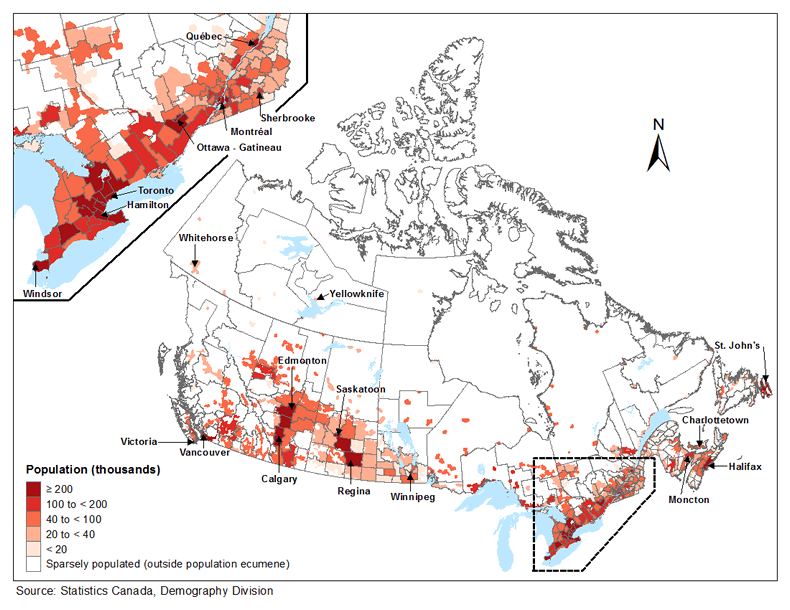
Just happens to magically connect the first (Toronto), second (Montreal), fourth (Ottawa-Gatineau) and seventh (Quebec City) largest Census Metropolitan Areas in the country. And as per the 2021 census, Quebec city is larger than every Ontario CMA West of Toronto.

Where you guys come up with this nonsense is beyond me.
 
And I was replying to someone who disagrees. 💁‍♂️
I said no such thing. Don't make assumptions.

If the goal (as ALTO seems to be touted as) is "nation-building", do we cater to populations that are already well serviced, or do we attempt to connect the whole country (if only part way)?

The maritimes have been typically shafted when it comes to rail, so putting something like this on their doorstep is both in the spirit of nation building, but also a peace offering.

The VIA from Moncton to Toronto currently takes over 26 hours. Alto will be able to knock several hours off that trip with a connection in Quebec City.
 
I presume this is an electrolysis corrosion concern? The added weight seems negligible even for overhead rail.
No, the issue is that the structure underneath the trainshed and tracks is hollow. Each track is running on girders that span this opening, and uses columns mounted in a row to support hem. This allows for the station's concourses to function underneath.

Moving the tracks will involve rebuilding all of that structure underneath them.

The weight of the catenary, even if it is built of conductor rail, is negligible in the grand scheme of things because the trainshed is held up with its own set of girders and columns above the concourse.

Dan
 

some food for thought about HSR from Adam something.
basically, the difference of like 20kph is like 4 minutes.
The swiss intentionally slow trains so they can speed up to make up delays.
Maybe instead of targeting 300 you target 250 so you can make the time up if youre late?
 
Just happens to magically connect the first (Toronto), second (Montreal), fourth (Ottawa-Gatineau) and seventh (Quebec City) largest Census Metropolitan Areas in the country. And as per the 2021 census, Quebec city is larger than every Ontario CMA West of Toronto.

Where you guys come up with this nonsense is beyond me.
Transport demand between cities is generally a function of how large the cities are and how close they are (in travel time). Quebec may be larger than London, Hamilton, and Kitchener, but its also significantly farther from Montreal than those cities are from Toronto (Quebec-Montreal is same distance as Toronto-Chatham). The fact that Toronto is even bigger than Montreal makes that demand that much higher. Now if you factor in cost to build i bet the quebec section is far cheaper per capita than any route from toronto to points west
 
Just happens to magically connect the first (Toronto), second (Montreal), fourth (Ottawa-Gatineau) and seventh (Quebec City) largest Census Metropolitan Areas in the country. And as per the 2021 census, Quebec city is larger than every Ontario CMA West of Toronto.

Where you guys come up with this nonsense is beyond me.
Perhaps because the Quebec CMA is 3,500 m² with only 840,000 people, while the adjacent Hamilton and KW are only about a combined 2,500 m² with 1,350,000 people. (and another 1,400,000 in London/Windsor/Niagara). And that doesn't include the relatively small Guelph and Brantford CMAs.

There's precious little immediately east of Quebec City.

1764345051705.png
 
Last edited:
From a feasibility standpoint jacking the shed would be possible while keeping the station in service. You would install the jacks one at a time during nightwork and cover them up with hoarding, if you cut into the columns and place the jack there it would not take up much more room than the column itself. Once all the jacks are in place, they would start jacking it during night work - perhaps at a very slow pace to ensure that the structure remains completely stable, at the end of each night you shore up the columns, disconnect the jacks, put the hoarding back up. Rinse and repeat until the desired height is achieved.

I too would rather they just demolish it, but there are certainly options.
 
I have a hard time believing that Peterborough is so politically important to either the federal or provincial government that HSR must go through it. If it was that important, VIA would still be funded to run there and/or GO would service it.

It strikes me that the routing through Peterborough is an outfall from the original HFR project utilizing the abandoned ROW. It will likely need a lot of alteration for the high speeds but I think a good portion of it will remain useable. I also suspect that a lot of the adjacent land in the Kaladar-Sharbot Lake area is Crown owned. Jumping on existing CN or CPKC rights-of-way muddies ownership and assumes the alignments are suitable for the higher speeds. Pretty much any other southern Ontario route would mostly certainly have be on 100% expropriated land.
 
Perhaps because the Quebec CMA is 3,500 m² with only 840,000 people, while the adjacent Hamilton and KW are only about a combined 2,500 m² with 1,350,000 people. (and another 1,400,000 in London/Windsor/Niagara). And that doesn't include the relatively small Guelph and Brantford CMAs.

Changes nothing. Take up your definition on how CMAs are defined with Stats Can. It's no different than why Oshawa is not part of the GTA, for example.
 

Back
Top