News   Dec 05, 2025
 673     2 
News   Dec 05, 2025
 2.2K     4 
News   Dec 05, 2025
 465     0 

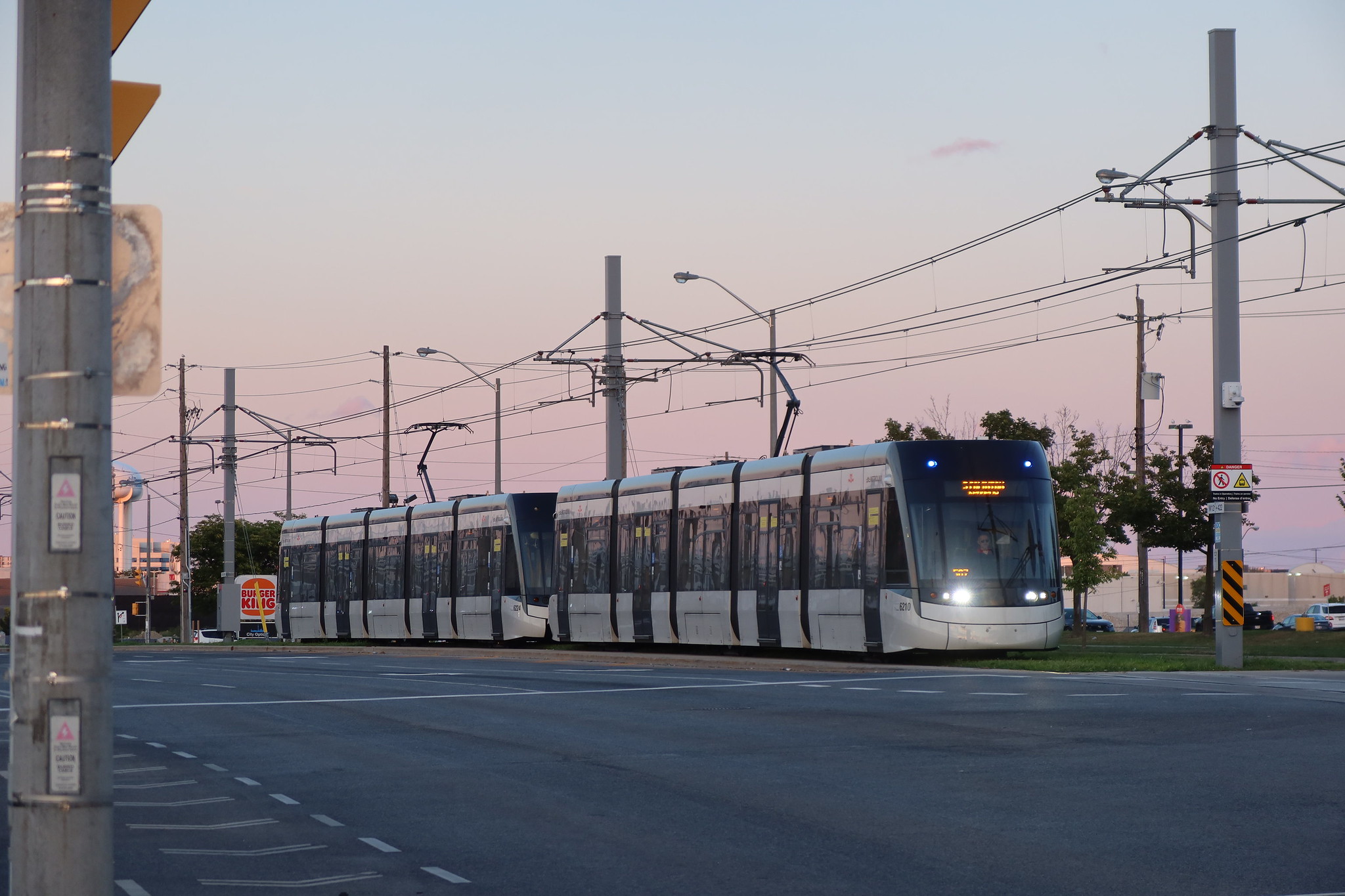
Toronto Eglinton Line 5 | ?m | ?s | Metrolinx | Arcadis

When I was a kid in Toronto, trains ran on the streets all the time in a nearby factory area. When our family drove out to do grocery shopping, we often had to wait for street trains to pass. I live in a different neighbourhood now, but there is a warehouse area nearby, and old tracks can be seen everywhere. In the 25 years I've lived here, most of the tracks have been removed, along with train crossing signs and other old markers. I found it interesting enough to take photos of tracks when I first moved here, and used Google Maps to map out where all the rails went, so I have something to compare to the present. Trains on streets can be dangerous and noisy - as a kid, I'd hear them all night - and few active lines remain, if any.

Here is a map I made, and just a couple of photos as an example. On the map, red lines are active right of way rail lines, green lines are inactive street rails, numbers show places where I took photos. The 2 photos shown are at location points 5 and 9. This is southwest of Eglinton and Don Mills.
View attachment 688449
View attachment 688450
View attachment 688451

Good effort; some of the tracks went much further west, almost to Laird. Map:

1760511897550.png


Source:: https://leasidelife.com/wp-content/uploads/2016/07/LesideMap-768x768.jpg
 
Consider this: As already stated (and can be verified at Wikipedia), the road was built on or after 1919. It's extremely unlikely they would have named it after Queen Victoria 2 decades after her death. If it had been named for the monarch of the time, it would have been called King's Quay. It must have been named for Elizabeth II in the 1950s or later.

Not necessarily.
The Queen Elizabeth Way highway was named after Queen Elizabeth the Queen Mother when she was Queen Consort to King George VI.
So there's Queen Alexandra, Queen Mary and Queen Elizabeth before Queen Elizabeth II.
 
Last edited:
Consider this: As already stated (and can be verified at Wikipedia), the road was built on or after 1919. It's extremely unlikely they would have named it after Queen Victoria 2 decades after her death. If it had been named for the monarch of the time, it would have been called King's Quay. It must have been named for Elizabeth II in the 1950s or later.

Many streets in Toronto changed their name in the 20th century. Usually the old name is no longer referenced, to avoid confusion. You can find old names on old maps, but it's rare to see them elsewhere, unless there's an interesting story behind the change.
Again, I know street name changes were fairly common, and I'm not expecting the name to be found on street signs. But if the road had originally been called Lakeshore, why would it not be mentioned on Wikipedia, for instance? The names of the streets that make up today's Dundas are not exactly difficult to find.

The best bet for producing a primary source that confirms the original name would be to investigate old maps through the TPL's digital archive, but it seems to be throwing back a 403 error. The city of Toronto only has one post 1919 fire insurance map, where neither a Lakeshore nor a Queens Quay exists, there seems to be some kind of access road called Lake Street that went as far as John Street. I have several old transit maps which were created in the 1970s by historian John Bromley, which otherwise make reference to former street names where appropriate, that refer to the street as Queens Quay going as far back as 1936, which I consider reliable as a secondary source.


Aha, here we go. Two maps, from the World War I era, by the Toronto Harbour Commissioners, showing the proposed development of the waterfront, with Queens Quay being the name of the street. As a primary source, I don't think you can get much better than this.


Last edited:
Again, I know street name changes were fairly common, and I'm not expecting the name to be found on street signs. But if the road had originally been called Lakeshore, why would it not be mentioned on Wikipedia, for instance? The names of the streets that make up today's Dundas are not exactly difficult to find.

The best bet for producing a primary source that confirms the original name would be to investigate old maps through the TPL's digital archive, but it seems to be throwing back a 403 error. The city of Toronto only has one post 1919 fire insurance map, where neither a Lakeshore nor a Queens Quay exists, there seems to be some kind of access road called Lake Street that went as far as John Street. I have several old transit maps which were created in the 1970s by historian John Bromley, which otherwise make reference to former street names where appropriate, that refer to the street as Queens Quay going as far back as 1936, which I consider reliable as a secondary source.

It was probably a colloquial name that was made permanent for new road later on.

Torontonians are not adverse to preferring colloquials; see "The Flatiron" (The Gooderham Building) or "Graffiti Alley" (Rush Lane). Both can be found as such on Apple & Google Maps, despite not being official names.
 
Again, I know street name changes were fairly common, and I'm not expecting the name to be found on street signs. But if the road had originally been called Lakeshore, why would it not be mentioned on Wikipedia, for instance? The names of the streets that make up today's Dundas are not exactly difficult to find.

The best bet for producing a primary source that confirms the original name would be to investigate old maps through the TPL's digital archive, but it seems to be throwing back a 403 error. The city of Toronto only has one post 1919 fire insurance map, where neither a Lakeshore nor a Queens Quay exists, there seems to be some kind of access road called Lake Street that went as far as John Street. I have several old transit maps which were created in the 1970s by historian John Bromley, which otherwise make reference to former street names where appropriate, that refer to the street as Queens Quay going as far back as 1936, which I consider reliable as a secondary source.


Aha, here we go. Two maps, from the World War I era, by the Toronto Harbour Commissioners, showing the proposed development of the waterfront, with Queens Quay being the name of the street. As a primary source, I don't think you can get much better than this.


🤪 Okay, I give up!
 
 
On the weekend I was in a car with friends coming back into the city, and while on Eglinton near Allen Road I made a comment about the unused "new" LRT stations, and people in the car -- new within the last year to Toronto -- weren't even sure what kind of transit it is, if it's above or below ground, or what the route is. I told them it's possible it will open in a couple months and they were excited, but shocked when I told them it was supposed to open years ago.

Anyway, I enjoy and think it benefits us to be reminded of the vast levels of understanding from regular people in the city about what's going on.
 
Is the whole Queens Quay-Lakeshore Road/Boulevard situation an example of the Mandela Effect? Although that would require us to be alive at the time Queens Quay was first built.
 
While of course it makes sense to promote a new line and i think its totally reasonable to run a bit if a campaign for it, I somhow doubt an lrt running along torontos busiest bus route will be underutilized due to the connections between train, bus, and subway alone.
 
Interesting question: If the complaint is that the Eglinton LRT cars are 10 years old already, then in 15 years, why not just move the Finch LRT cars over to the Eglinton line and buy new cars for the Finch line instead of having to buy all new cars for both lines in the future...?
Sounds like a nice quick fix solution.
 
While of course it makes sense to promote a new line and i think its totally reasonable to run a bit if a campaign for it, I somhow doubt an lrt running along torontos busiest bus route will be underutilized due to the connections between train, bus, and subway alone.
thanks for sharing and I agree with your comment. I was a bit disappointed at the lack of detail or information for a Lorinc article. The TTC has a marketing campaign right now where they are showcasing areas of the city to explore that are accessible by transit. It is natural to assume this would be extended to the Crosstown stops.

given how cautious the city/province is in rolling this thing out, I imagine they also want to slowly ramp up ridership. I'm sure there will be kinks to work out before they roll out a marketing campaign?
 

Back
Top