News   Dec 05, 2025
 178     0 
News   Dec 05, 2025
 1.1K     2 
News   Dec 05, 2025
 329     0 

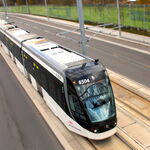
Toronto Eglinton Line 5 | ?m | ?s | Metrolinx | Arcadis

If the line can handle the demand, just runs slower than it could in the east
If trains run slower in the eastern portion compared to the rest of the line, won't it lead to "bunching up" of trains? Something similar to what we see with the streetcars in downtown.


Just think of Subway Line 1 that has a few slow-order sections; those stretches are a bit annoying, but noone panics.
They're totally unacceptable and make transit less desirable. We shouldn't try to normalize this.
 
If trains run slower in the eastern portion compared to the rest of the line, won't it lead to "bunching up" of trains? Something similar to what we see with the streetcars in downtown
No, because the streetcars are bunched up downtown due to poor schedule management and operators playing games.

If all vehicles operate at the same speed, and at the same headway, they will each arrive at a given point in correct time. If one vehicle travels 80 km most of the way, then 50 km the rest of the way (example speeds), the only way that a second vehicle will be able to catch up and bunch is if it is travelling at a markedly different speed than its leader. All that will change is how quickly they will travel between stops.
 
I get what you're saying. From my experience, light rail on Eglinton might just end up being a mess, especially with the at-grade sections. I’ve seen how gridlock can ruin things, and having multiple vehicles show up at once just creates chaos. In my opinion, short-distance subways that make more frequent stops would be a lot better. They’d handle the crowding way better than an LRT that struggles with traffic. The Eglinton subway sounds like a more practical solution to me.
 
It's really frustrating how Metrolinx is constructing every transit line to different parameters & specifications. Even different voltage setups for the electrical systems for both the Finch and Eglinton LRT lines.
Well, hold on here.

First off, it was the TTC, not Metrolinx that created the standards for the LRT lines.

And the LRT lines are being standardized - just not to a standard seen before in Toronto. 750V dc, standard gauge, 25m curves and 8.8m wide cars is a standard used all around the world, with cars produced by a multitude of vendors. And in that case, that's fine as there was going to be maybe only one place where they could have interfaced with the legacy streetcar fleet - at Jane and St. Clair. They didn't need to be interoperable with the legacy Toronto system, they only needed to be interoperable with themselves - and by and large, they will be. (Yes, the signal systems will be different, but at the end of the day that's a far less big deal than the others.)

Why does Metrolinx appear to see no value in any kind of standardization/ interoperability among Toronto's transit line?
It's easy to do so when you have no capability for corporate history. Or worse yet, you're fresh out of university and haven't yet had the experience to see why things are done in the way they are. Both of these are the case at Metrolinx.

"It's always been done that way" can be a failing. But in many cases it's also because it was found a long time ago to be the best way to do things considering the circumstances.

The lack of interoperability among Toronto's newest transit lines is going to be expensive in the long run.
Within reason, yes. If all of the LRTs were the same type and manufacturer then they'd all use the same parts, and so the fact that they were spread around to two or three different places wouldn't be such a big deal. And the sheer number of vehicles required for the Ontario Line will mean that no matter what it was always going to require it's own facilities and tools and techniques that would rival Greenwood or Wilson.

Dan

 
If trains run slower in the eastern portion compared to the rest of the line, won't it lead to "bunching up" of trains? Something similar to what we see with the streetcars in downtown.

It does not have to. In the slower section of the line, the distance between the trains will be shorter, but the time between arrivals at each stop will be the same as in the faster section.

They're totally unacceptable and make transit less desirable. We shouldn't try to normalize this.

Sure you can write to your city councillor, and ask to repair the tracks ASAP. What I mean is that noone suggests digging up and rebuilding Line 1 because of those problems.
 
This is incorrect, isn’t it? Aren’t both Finch and Eglinton 750VDC?

(The downtown network IS different, being 600VDC)
Yes it’s incorrect. Not sure where he got that info from. Previous government made an emergency order of Alstom vehicles to use on Eglinton as they thought Bombardier couldn’t deliver on time (now that’s funny on its own). So of course the Alstom vehicle and Bombardier vehicle would have to use the same power supply.
Now, the Alstom vehicles are exclusively for Finch and Bombardier (now Alstom anyways) are exclusively for Eglinton. The Alstom units are longer and 2 alstoms = 3 bombardiers in length.
 
It does not have to. In the slower section of the line, the distance between the trains will be shorter, but the time between arrivals at each stop will be the same as in the faster section.


Sure you can write to your city councillor, and ask to repair the tracks ASAP. What I mean is that noone suggests digging up and rebuilding Line 1 because of those problems.
I don't really understand the comparison here. Lots of people are very frustrated with slow zones or other limitations on line 1. They don't suggest rebuilding line 1 because that is obviously not the solution to the problem, maintenance and modernization is, and that is clearly on the long-term agenda!

Even with theoretically perfect operation and maintenance there are non-trivial capacity and speed limitations to road median tramways that grade separation potentially addresses. Whether you think that eventually will/should happen is another thing that I don't really care to argue about, but it's clearly not unorthodox. The first ttc subways were themselves built to replace streetcar lines. And the SSE most recently was always premised on ripping up the RT. Transit infrastructure is often iterative, this seems rather uncontroversial to me
 
It's has to be one of the GO train's biggest strengths. It makes the system so versatile and efficient. Not just in terms of operations but also in managing staff and ordering spare parts. Plus using existing infrastructure.

How many different types of rolling stock does the city of Toronto require? So now we have to train mechanics to maintain every different type of train, and train drivers to operate every different type of train. Order different parts/ components for all the different rolling stock. What a nightmare to manage. More people on the government payroll to oversee all of this.

I believe mechanics are generally supplied by the manufacturer as part of the purchase. I get standardization of the track widths, but standardization of rolling stock means less flexibility and a greater chance of a systemwide problem. If all Flexity trains were found to have a potentially fatal flaw in them, our entire streetcar system would be shut down right now (ahem, moreso than it currently is). If the Toronto Rockets had a similar type of flaw, we could at least pull the old T1s onto the Yonge line and provide at least some semblance of service for a while. Having mixed stock is an advantage.

Likewise, costs go up with standardized stock. Once you're set with a particular stock, you're stuck with it. No leverage for better pricing, no incremental improvements in the vehicles, etc. And the manufacturer knows that. You'll end up paying more in the long run.

In Europe, standardized stock is not very common across an entire system, and we should be following their example in transit value for money.
 
How many different types of rolling stock does the city of Toronto require? So now we have to train mechanics to maintain every different type of train, and train drivers to operate every different type of train. Order different parts/ components for all the different rolling stock. What a nightmare to manage. More people on the government payroll to oversee all of this.
Two points I would make here, as economy of scale flits into and out of a lot of these discussions.

1. When it suits, such economies are overlooked. Canada Line, having different DMUs for Ottawa Line 2 and 4, UPX cars and now Guelph-Cambridge BEMUs. On the flip side, economy of scale was used to sell the TTC 600 car mega order for uptown and downtown LRVs for Transit City to ensure Thunder Bay got all the work and look how that worked out. Even if the uptown work had been separately tendered it would have created a light rail order of a size roughly that of the entire US light rail fleet - and there’s a good chance the assembly plant might have been located somewhere close enough that Torontonians could work at it* or even have the vehicles driven out of an assembly plant convertible to an MSF**

2. Different vehicles are not necessarily that different. LRVs these days are an assembly of components - electrical, motors, seating, lighting - from a global supply chain. I would love to know what overlap there is between Citadis Spirit and Flexity Freedom but I doubt it’s zero. Additionally, there may not be much choice but to use a common supplier in some situations where a country has only one supply of a specific part but that part is the most convenient one to select for national-content-percentage purposes.

* this is not necessarily a guarantee of a good product - see BYD Newmarket and their vehicles’ woes at TTC
** again not a guarantee of a good outcome - see Ottawa
 
** again not a guarantee of a good outcome - see Ottawa
Ottawa is not a good example of standardization not working because everyone, including Alstom themselves was telling the City of Ottawa that the trains they wanted wouldn't work properly on the line.

It's not a case against standardization. It's a case of city officials ignoring all the experts and gunning ahead regardless.
 
Ottawa LRVs couldn't even run on any ML LRT lines or the ION. Somehow they chose 1500V DC oppose to the standard 750V DC. The Citadis was suppose to be the backup car for the crosstown so they should at least be able top run on the line manually.
 
If all vehicles operate at the same speed,
Does this mean trains going through the underground and grade separated portions of the line will be relegated to travel at the same speed as the trains travelling along the eastern/ at grade portion of the line?


What I mean is that noone suggests digging up and rebuilding Line 1 because of those problems.
I don't think it's necessary to combat slow zones by digging up the track and rebuilding the entire line.


I was wrong about the voltage. Both Finch and Eglinton will use 750DC. I previously asked in this thread if it was possible to connect both lines in the future. Someone had responded to me that it wouldn't be possible to connect the lines because both use different voltage.
So would it be possible to connect both the Eglinton line and Finch line at some point in the future? Perhaps at Toronto Pearson airport?
 
Does this mean trains going through the underground and grade separated portions of the line will be relegated to travel at the same speed as the trains travelling along the eastern/ at grade portion of the line?


I don't think it's necessary to combat slow zones by digging up the track and rebuilding the entire line.


I was wrong about the voltage. Both Finch and Eglinton will use 750DC. I previously asked in this thread if it was possible to connect both lines in the future. Someone had responded to me that it wouldn't be possible to connect the lines because both use different voltage.
So would it be possible to connect both the Eglinton line and Finch line at some point in the future? Perhaps at Toronto Pearson airport?

Eglinton crosstown and Finch West LRT use different signalling systems that are incompatible for interoperability.

So, short answer is no, the LRVs will not be able to interchange at Pearson right away.

That being said, the Pearson connection is at least 10-15 years away and Metrolinx may invest in a way to allow for interoperability. At a minimum, I believe they will include crossover tracks at Pearson to eventually be used to interline the trains once the signalling system is figured out.

The other issue is platform length. The 2-car Crosstown LRVs with a total length of 60m will not fit on the Finch surface platforms which are currently only 45m long. Either the Finch platforms have to be extended or the trailing Crosstown car in the Crosstown 2-car set will have a couple of its doors out of service when travelling on Finch.
 

Back
Top