

E
Ed007Toronto
Guest
Under Construction:
Toronto as an Architectural Tourist Site
By DAVID D'ARCY
September 6, 2006; Page D10
Toronto
Spiny steel girders frame Daniel Libeskind's new addition to the Royal Ontario Museum, the stone repository of history, science, decorative arts and archaeology founded in 1914. Libeskind sketched the "Crystal" on a napkin after visiting the ROM's vast minerals collection. The jagged 240 million Canadian dollar (US$217.1 million) silhouette opens to tourists in May 2007.
Other institutions are racing to ready buildings too. Next week, Wagner's "Ring" is the debut production in the Four Seasons Centre for the Performing Arts, an opera house designed by the Toronto architect Jack Diamond. Toronto-born Frank Gehry has shuttered most of the Art Gallery of Ontario (AGO) for an expansion, and the local firm Kuwabara Payne McKenna Blumberg has renovated the Gardiner Museum of Ceramics. Next to the ROM is the Royal Conservatory of Music, also a KPMB renovation. A Libeskind high-rise is planned near the waterfront.
Nearby, the University of Toronto has unveiled a pharmacology building by Sir Norman Foster and a science center by Stefan Benisch, with more construction to come. Luxury towers crowd around its borders like long-stemmed weeds mulched by culture.
The Crystal, the Daniel Libeskind-designed addition to the Royal Ontario Museum, will open to the public in May 2007. Other city institutions are also expanding.
Toronto is buying into the power of architecture -- to lure tourists, professionals and investors and to market its cultural makeover-in-progress. In Canada's livable largest city, being "Toronto the good" is no longer good enough. "Toronto is a psychologically insecure place," says George Baird, dean of architecture at the University of Toronto. "We really want you Americans to be more impressed with us than you are, even though you're barely aware we exist." Tourism, never high, lags below 2001 levels.
A mile south of Mr. Libeskind's Crystal, one sign of the new Toronto is the Sharpe Center of the Ontario College of Art and Design (OCAD), a rectangle spotted with pixils by the British architect Will Alsop and perched on brightly colored slanted steel beams eight stories above a public square. This cartoony "cow on stilts" has upstaged Mr. Gehry's AGO expansion next door. Completed for C$42 million, it's won Mr. Alsop the commission for the C$275 million Filmport, a waterfront movie-production hub.
In Mr. Gehry's subdued plan, a swirled staircase extruding from a sheer back wall hints at a Gehry "signature." Glass will sheathe 40% more gallery space than AGO's 1993 renovation contained, thanks to the late newspaper mogul Kenneth Thomson, Canada's richest man, who pledged C$70 million toward the renovation and 2,000 works of art to the collection. Some 80 African objects will come from Murray Frum, a local developer and father of former Bush scribe David Frum.
In most cases, mixed-use drives the financing. The Toronto International Film Festival's new home -- six floors of cinemas and offices topped by a 30-story condominium -- will rise from a parking lot owned by the family of "Ghostbusters" director Ivan Reitman. Mr. Reitman partnered with a local builder and with the film festival, opening Thursday, which brings more income to Toronto than any other cultural event. KPMB's design by Bruce Kuwabara has wide steps rising to the sixth floor roof, an homage to the stairs of the 1936 Villa Malaparte on Capri, a location in Jean-Luc Godard's "Contempt."
The boosterism is limitless. AGO T-shirts display Gehry's initial design scrawl. Libeskind's Crystal napkin sketch hangs in a ROM gallery. You hear the term "world class" in Toronto as often as in Las Vegas.
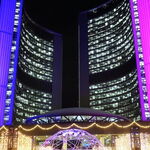
In Toronto's 40-year rise from a backwater into Canada's wealthiest urban sprawl, architecture was mostly functional and forgettable. (Yet blandness is an asset, drawing Hollywood to locations here that can look like anywhere in the U.S., only cheaper to film.) Toronto's rare modern landmarks include its 1965 City Hall, two tall crescent curves around a saucer shape by the Finnish architect Veljho Revell, and Mies van de Rohe's rectilinear towers and pavilion of the 1967 Toronto-Dominion Centre.
Today's cultural surge dates from 2002, when the city and provincial governments launched "Superbuild," an initiative to expand cultural institutions. Those now building lined up. William Thorsell, the former editor of the Toronto Globe and Mail who has headed the ROM since 2000, calls the program a "Plan B" conceived after Toronto lost its bid to jumpstart a makeover with the 2008 Olympics. Officials saw Superbuild as a one-time shot to wean local institutions off the single-payer state model for cultural funding.
Money drew others to the trough, like the Hummingbird Center, an auditorium built near the waterfront in the 1960s for opera, pop and ballet that was once the O'Keefe Center. (Hummingbird, a software maker, bought renaming rights from a brewery for some C$5 million.) The hall's fate hovered between demolition and unfunded renovation, until a developer proposed a Libeskind luxury tower above it. Mr. Libeskind calls his knife-like twist on the Nike swoosh "a bird in space" -- for critics, it's a boot. The project still seeks a corporate sponsor for C$30 million -- and it needs to make up C$15 million promised by the Liberal Party, which lost the last federal election.
In his office in City Hall, Toronto's mayor, David Miller, called the new cultural buildings "infrastructure" that he said should boost lagging tourism by 10% in each of the next five years. Yet some fear that, once the scaffolds go, central Toronto will be an archipelago of bill-paying condos shooting skyward from low-lying museums or theaters. At the Hummingbird Center, Libeskind's shadowy spire will rise out of a 1960s base. At the Younge Centre, a theater complex in a Victorian distillery, the sleek "Pure Spirit" tower seeks buyers. The towers conjure up images of a tall cactus sprouting out of the smaller plant that nourishes it.
Some institutions forced to be entrepreneurial have made false starts. The new AGO expansion for the collection of Kenneth Thomson razes the Joey and Toby Tanenbaum Sculpture Atrium, a previous major donor's gift. Mr. Tanenbaum left the board, swearing, "They're not going to suck me dry." The AGO has reconciled with Mr. Tanenbaum, but public funder-fury could scare off new philanthropists.
At the ROM, the museum and a developer planned ROM South, a 46-story tower by a local architect, atop a planetarium on its southern perimeter that shut when state funds fell short in the early 1990s. The most expensive apartments in Toronto would have housed six museum floors and brought the ROM C$20 million. Yet neighbors (followers of Toronto's late Jane Jacobs) feared long shadows on University of Toronto lawns and the stigma of the condo-rich lording over a public institution. Mr. Thorsell surrendered to public ire last November. The ROM unveiled airy Chinese galleries in mid-December, but postponed the Libeskind Crystal's opening.
Boosterism aside, the most successful buildings may be more discreet than sculptural. With gentler gestures, Kuwabara Payne McKenna Blumberg's newly opened C$100 million National Ballet School integrates dance studios on five floors with an auditorium and administrative offices in 19th-century houses. The school shares its site with -- what else? -- two condo towers, modest at less than 30 stories. On Jarvis Street, reclaimed from hookers and addicts, passersby can view rehearsals through glass walls on the upper floors. It is a destination for students, not tourists.
Likewise, Mr. Diamond's new opera house understates its façade and dispenses with a central staircase, stressing acoustics in a hall two-thirds the capacity of the one it replaces. Wagner's "Ring," which debuts next week, is sold out.
Even critics say the town's architecture fervor is a great step forward, but its donors may be tapped out, since Toronto philanthropy lacks deep roots. "The pool here is deeper than before," contends Murray Frum. "Is it deep like in New York? Absolutely not. But it's deep enough." Deep enough to complete the buildings under way? Insiders say donors who've already given can't afford to see their projects fail.
Mr. Thorsell of the ROM asks for trust in building and running his museum, once he pays for completing it: "If we can't do that with the content, with the renovations, with the Crystal, with the amenities in this town, I'll go into exile." Staying put, in his case, will mean raising an additional C$36 million.
Mr. D'Arcy is a correspondent for the Art Newspaper.
Toronto as an Architectural Tourist Site
By DAVID D'ARCY
September 6, 2006; Page D10
Toronto
Spiny steel girders frame Daniel Libeskind's new addition to the Royal Ontario Museum, the stone repository of history, science, decorative arts and archaeology founded in 1914. Libeskind sketched the "Crystal" on a napkin after visiting the ROM's vast minerals collection. The jagged 240 million Canadian dollar (US$217.1 million) silhouette opens to tourists in May 2007.
Other institutions are racing to ready buildings too. Next week, Wagner's "Ring" is the debut production in the Four Seasons Centre for the Performing Arts, an opera house designed by the Toronto architect Jack Diamond. Toronto-born Frank Gehry has shuttered most of the Art Gallery of Ontario (AGO) for an expansion, and the local firm Kuwabara Payne McKenna Blumberg has renovated the Gardiner Museum of Ceramics. Next to the ROM is the Royal Conservatory of Music, also a KPMB renovation. A Libeskind high-rise is planned near the waterfront.
Nearby, the University of Toronto has unveiled a pharmacology building by Sir Norman Foster and a science center by Stefan Benisch, with more construction to come. Luxury towers crowd around its borders like long-stemmed weeds mulched by culture.
The Crystal, the Daniel Libeskind-designed addition to the Royal Ontario Museum, will open to the public in May 2007. Other city institutions are also expanding.
Toronto is buying into the power of architecture -- to lure tourists, professionals and investors and to market its cultural makeover-in-progress. In Canada's livable largest city, being "Toronto the good" is no longer good enough. "Toronto is a psychologically insecure place," says George Baird, dean of architecture at the University of Toronto. "We really want you Americans to be more impressed with us than you are, even though you're barely aware we exist." Tourism, never high, lags below 2001 levels.
A mile south of Mr. Libeskind's Crystal, one sign of the new Toronto is the Sharpe Center of the Ontario College of Art and Design (OCAD), a rectangle spotted with pixils by the British architect Will Alsop and perched on brightly colored slanted steel beams eight stories above a public square. This cartoony "cow on stilts" has upstaged Mr. Gehry's AGO expansion next door. Completed for C$42 million, it's won Mr. Alsop the commission for the C$275 million Filmport, a waterfront movie-production hub.
In Mr. Gehry's subdued plan, a swirled staircase extruding from a sheer back wall hints at a Gehry "signature." Glass will sheathe 40% more gallery space than AGO's 1993 renovation contained, thanks to the late newspaper mogul Kenneth Thomson, Canada's richest man, who pledged C$70 million toward the renovation and 2,000 works of art to the collection. Some 80 African objects will come from Murray Frum, a local developer and father of former Bush scribe David Frum.
In most cases, mixed-use drives the financing. The Toronto International Film Festival's new home -- six floors of cinemas and offices topped by a 30-story condominium -- will rise from a parking lot owned by the family of "Ghostbusters" director Ivan Reitman. Mr. Reitman partnered with a local builder and with the film festival, opening Thursday, which brings more income to Toronto than any other cultural event. KPMB's design by Bruce Kuwabara has wide steps rising to the sixth floor roof, an homage to the stairs of the 1936 Villa Malaparte on Capri, a location in Jean-Luc Godard's "Contempt."
The boosterism is limitless. AGO T-shirts display Gehry's initial design scrawl. Libeskind's Crystal napkin sketch hangs in a ROM gallery. You hear the term "world class" in Toronto as often as in Las Vegas.
In Toronto's 40-year rise from a backwater into Canada's wealthiest urban sprawl, architecture was mostly functional and forgettable. (Yet blandness is an asset, drawing Hollywood to locations here that can look like anywhere in the U.S., only cheaper to film.) Toronto's rare modern landmarks include its 1965 City Hall, two tall crescent curves around a saucer shape by the Finnish architect Veljho Revell, and Mies van de Rohe's rectilinear towers and pavilion of the 1967 Toronto-Dominion Centre.
Today's cultural surge dates from 2002, when the city and provincial governments launched "Superbuild," an initiative to expand cultural institutions. Those now building lined up. William Thorsell, the former editor of the Toronto Globe and Mail who has headed the ROM since 2000, calls the program a "Plan B" conceived after Toronto lost its bid to jumpstart a makeover with the 2008 Olympics. Officials saw Superbuild as a one-time shot to wean local institutions off the single-payer state model for cultural funding.
Money drew others to the trough, like the Hummingbird Center, an auditorium built near the waterfront in the 1960s for opera, pop and ballet that was once the O'Keefe Center. (Hummingbird, a software maker, bought renaming rights from a brewery for some C$5 million.) The hall's fate hovered between demolition and unfunded renovation, until a developer proposed a Libeskind luxury tower above it. Mr. Libeskind calls his knife-like twist on the Nike swoosh "a bird in space" -- for critics, it's a boot. The project still seeks a corporate sponsor for C$30 million -- and it needs to make up C$15 million promised by the Liberal Party, which lost the last federal election.
In his office in City Hall, Toronto's mayor, David Miller, called the new cultural buildings "infrastructure" that he said should boost lagging tourism by 10% in each of the next five years. Yet some fear that, once the scaffolds go, central Toronto will be an archipelago of bill-paying condos shooting skyward from low-lying museums or theaters. At the Hummingbird Center, Libeskind's shadowy spire will rise out of a 1960s base. At the Younge Centre, a theater complex in a Victorian distillery, the sleek "Pure Spirit" tower seeks buyers. The towers conjure up images of a tall cactus sprouting out of the smaller plant that nourishes it.
Some institutions forced to be entrepreneurial have made false starts. The new AGO expansion for the collection of Kenneth Thomson razes the Joey and Toby Tanenbaum Sculpture Atrium, a previous major donor's gift. Mr. Tanenbaum left the board, swearing, "They're not going to suck me dry." The AGO has reconciled with Mr. Tanenbaum, but public funder-fury could scare off new philanthropists.
At the ROM, the museum and a developer planned ROM South, a 46-story tower by a local architect, atop a planetarium on its southern perimeter that shut when state funds fell short in the early 1990s. The most expensive apartments in Toronto would have housed six museum floors and brought the ROM C$20 million. Yet neighbors (followers of Toronto's late Jane Jacobs) feared long shadows on University of Toronto lawns and the stigma of the condo-rich lording over a public institution. Mr. Thorsell surrendered to public ire last November. The ROM unveiled airy Chinese galleries in mid-December, but postponed the Libeskind Crystal's opening.
Boosterism aside, the most successful buildings may be more discreet than sculptural. With gentler gestures, Kuwabara Payne McKenna Blumberg's newly opened C$100 million National Ballet School integrates dance studios on five floors with an auditorium and administrative offices in 19th-century houses. The school shares its site with -- what else? -- two condo towers, modest at less than 30 stories. On Jarvis Street, reclaimed from hookers and addicts, passersby can view rehearsals through glass walls on the upper floors. It is a destination for students, not tourists.
Likewise, Mr. Diamond's new opera house understates its façade and dispenses with a central staircase, stressing acoustics in a hall two-thirds the capacity of the one it replaces. Wagner's "Ring," which debuts next week, is sold out.
Even critics say the town's architecture fervor is a great step forward, but its donors may be tapped out, since Toronto philanthropy lacks deep roots. "The pool here is deeper than before," contends Murray Frum. "Is it deep like in New York? Absolutely not. But it's deep enough." Deep enough to complete the buildings under way? Insiders say donors who've already given can't afford to see their projects fail.
Mr. Thorsell of the ROM asks for trust in building and running his museum, once he pays for completing it: "If we can't do that with the content, with the renovations, with the Crystal, with the amenities in this town, I'll go into exile." Staying put, in his case, will mean raising an additional C$36 million.
Mr. D'Arcy is a correspondent for the Art Newspaper.
