News   Feb 27, 2026
 5K     5 
News   Feb 27, 2026
 967     0 
News   Feb 27, 2026
 981     0 

TTC Cartography, Signage, and Wayfinding

In addition to just "above" the doorway, shouldn't they be at right-angle to the doorway. That way as you are inside walking along you can see the doorway you are aiming for.
The way they want is for you to look for the bus bay number, not the route number. The bus bay should be numbered chronologically (which is not done so for route numbers in any bus terminals that I know of). You don't need to know what comes after bus bay 1 and etc. They can add a bus terminal layout diagram for those who prefer a more visual presentation.
As for regular riders, they already know where to go without looking for the bus bay number.
 
Because if you go to that very same station, you'll find the wayfinding (if you're lucky to find them easily) for the individual bus routes at the bus bays to be laughably pathetic.

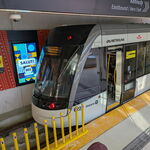
The wayfinding in this photo here is very good yes, but there are still wide ranging cases where Metrolinx wayfinding is pathetic.
I agree; there's a step missing: you need a buses from here map in the bus bay to help you understand which route you need and then from there you can pick the bay where your bus will arrive. I can't remember if there was a screen or even a printed map that was planned that was descoped or what happened to it but the bus terminal is set up pre-supposing you know what route you need. Diagrams for each route were added at the door to each bay recently but in theory you would have to look at all of them to confirm which bay you needed. There should be a consolidated map like the one in the photo to support that decision when you first arrive at the terminal
 
Pardon me if this has been discussed but has the TTC adopted the as the rapid transit designation? I believe this started with Finch and Eglinton Crosstown, but I assumed it was the Province going alone like their grey LRT vehicles going over TTC guidelines and making their own.

From a Scarborough subway extension presentation:

tempImage122lZh.png
 
Pardon me if this has been discussed but has the TTC adopted the as the rapid transit designation? I believe this started with Finch and Eglinton Crosstown, but I assumed it was the Province going alone like their grey LRT vehicles going over TTC guidelines and making their own.

From a Scarborough subway extension presentation:

View attachment 716845
I don't believe the TTC has any unique designs for the SSE, they are simply reusing marketing materials provided by Metrolinx.
 
Pardon me if this has been discussed but has the TTC adopted the as the rapid transit designation? I believe this started with Finch and Eglinton Crosstown, but I assumed it was the Province going alone like their grey LRT vehicles going over TTC guidelines and making their own.

From a Scarborough subway extension presentation:

View attachment 716845
The TTC has not adopted this.

Since the Scarborough subway extension is a Metrolinx project, that's why we're seeing this.

But you raise a good question, because unless the TTC plans on adopting Metrolinx wayfinding standards, we'll end up with 2 competing wayfinding standards for the same subway line.
 
But you raise a good question, because unless the TTC plans on adopting Metrolinx wayfinding standards, we'll end up with 2 competing wayfinding standards for the same subway line.
We unfortunately already have that. Or at least a Crosslinx standard and Metrolinx standard mix on the Eglinton line. Kennedy station might actually have all three. I didn’t look closely.
 
The TTC has not adopted this.

Since the Scarborough subway extension is a Metrolinx project, that's why we're seeing this.

But you raise a good question, because unless the TTC plans on adopting Metrolinx wayfinding standards, we'll end up with 2 competing wayfinding standards for the same subway line.

I’m fine with the as long as the TTC doesn’t ditch their iconic 3D logo outside subway stations that replicate the London Underground branding strategy.

default.jpg
 
Pardon me if this has been discussed but has the TTC adopted the as the rapid transit designation? I believe this started with Finch and Eglinton Crosstown, but I assumed it was the Province going alone like their grey LRT vehicles going over TTC guidelines and making their own.

From a Scarborough subway extension presentation:

View attachment 716845
I don't think the T was ever meant to be a rapid transit designation since they use it for bus stops too. It could have been an effective rapid transit designation but they've diluted it to the point where it's meaningless.

I’m fine with the as long as the TTC doesn’t ditch their iconic 3D logo outside subway stations that replicate the London Underground branding strategy.

default.jpg
This doesn't replicate the Underground branding strategy. The fact that it's 3D doesn't change the fact that It's the corporate TTC logo that's used for every bus and streetcar stop and other facilities operated by the TTC. While London does use a roundel for its bus stops, it's a simplified single colour version that's different from the ones used for the underground and overground.

Both the TTC and Metrolinx lack a distinct identifier of rapid transit.
 
Both the TTC and Metrolinx lack a distinct identifier of rapid transit.
As does most cities. Look at NYC - is there even any identifier other than a subway sign or route number - but then there's commuter trains? And the one subway line in Manhattan not operated by MTA doesn't even have that!

Montreal uses different signage for Metro, REM, and Exo.

Even in London, there's no roundels of any type on Govia's Thameslink line. Or the their Northern City underground line - including the deep level Essex Road tube station.

1771877754911.png
1771877857975.png


1771878005450.png

Essex Road doesn't even get the Great British Rail symbol, despite being operated by the same company as the Thameslink line!
 
The TTC has not adopted this.

Since the Scarborough subway extension is a Metrolinx project, that's why we're seeing this.

But you raise a good question, because unless the TTC plans on adopting Metrolinx wayfinding standards, we'll end up with 2 competing wayfinding standards for the same subway lin

The TTC has not adopted this.

Since the Scarborough subway extension is a Metrolinx project, that's why we're seeing this.

But you raise a good question, because unless the TTC plans on adopting Metrolinx wayfinding standards, we'll end up with 2 competing wayfinding standards for the same subway line.

I want to clear up an assumption that the two standards are in competition. That framing does not match the intent of the Metrolinx program, and it also does not reflect how these projects are procured and delivered.

For provincially delivered projects under AFP, the Metrolinx standard is currently the only standard which meets the province’s contractual requirements, including French language content but most importantly, performance-based specification language. TTC specifications are prescriptive, and under AFP that approach creates liability risks for the contracting authority and so is not permitted by IO. Setting regional integration aside, the practical reality is that provincial projects will specify the Metrolinx standard because it is the only one compatible with the delivery model.

Where the two standards differ is in how they expect customers to understand information. TTC tends to reduce what a customer has to interpret by using a small set of repeated graphic elements, for example using a single marker to carry multiple meanings (circle and number to mean mode, line, platform, etc). Metrolinx tends to separate concepts so the information is more self-evident to someone who has not “learned the system” yet. Mode is presented as mode, line is presented as line, and text is used to remove ambiguity in virtually all cases.

A simple example is platform direction. A TTC sign would say "(2) Kennedy.” A Metrolinx sign would say "(2) to Kennedy” (with French as required). These do not compete. Someone who understands the TTC format will understand the Metrolinx format. The reverse is less certain because “Kennedy” is doing two jobs at once in the TTC version, and the absence of “to” can make the line name and destination read the same way. If the destination is also a line name, like Finch West, it can create a moment of uncertainty about whether “(6) Finch West” is telling you which trains you are boarding or where they are going.

It is also worth saying, plainly and neutrally, that TTC was engaged during the development of the Metrolinx standard, and departures from TTC practice were made where there was a defensible benefit, such as legibility and ease of use. All issues that TTC flagged were addressed, including a number of costly late-stage changes on some projects tied to branding and bilingual requirements, which Metrolinx nevertheless adopted. So despite having addressed all issues raised on the topic in a manner that TTC accepted, sometimes at considerable cost, the use of two standards continue to persist instead of one.

On operator identity, the current approach seen in the renderings shared is much more balanced than the previous versions and was an easy compromise to make. They even were designed by the same designers as the TO360 signage so they would look like they were part of the same family (and now offer a way TO360 maps and TTC station ID signs can be combined; they currently are not, e.g. Dundas West). The key customer need is a clearly identifier of access to transit at the point of decision. Whether someone uses an operator logo or a generic symbol like the T is not super important as they're both there both can do the job for customers who are more familiar or less so. The exact order of marks matters less than consistency and visibility. Treating the shared regional symbol as fixed, with the operator identity placed prominently in a predictable location, seems a pretty defensible way forward to support both needs.

Finally, consistency within a station matters more to most customers than consistency across every station on a line. Most customers experience a small subset of stations repeatedly, and what helps them navigate those environments most easily is whether the station behaves consistently from entrance to platform to exit. The TTC system already has multiple generations of wayfinding in service along the same lines as upgrades roll out, and customers manage that because each station is internally coherent. Other networks also manage mixed standards over time, as long as the station-level experience is consistent.

I hate to burst everyone's bubble but If the goal is better wayfinding outcomes, we need to shift our priorities from making everything uniform graphically and worry more about coordination between how information is presented in one operators area versus another. The problem with Kennedy is not necessarily that multiple standards are used, it's that they were applied in isolation, with no concern for whether sign messages in one operator's space continued beyond in a way that made sense. There is much much more work that needs to be done on governance, and ensuring flexibility within contract compatible standards, along with bolstering review and assurance processes so if no coordination is happening there's a defined collaboration process that allows the necessary change to take place while minimizing extra costs, so a project doesn't open with glaring deficiencies which Project Co shrugs off. There needs to be a systematic approach to how delivery is managed and how Project Cos can be compelled to perform. People transition between different wayfinding systems all the time; the Eaton Centre has directions to the subway on all its overhead signage using a completely different icon than either TTC or Metrolinx, but people manage, because someone looked at it and said "this needs the word subway people won't mix up what this is directing to." The ability to have that kind of feedback listened to and actioned is the biggest hurdle to addressing the multi standards issues at the moment.
 
I don't think the T was ever meant to be a rapid transit designation since they use it for bus stops too. It could have been an effective rapid transit designation but they've diluted it to the point where it's meaningless.
It means 'transit'. It appears at points of access to transit and on information about transit. Those are its only applications. There we already multiple ways to identify rapid transit so I'm not sure why an additional one was thought to be useful. People generally use operator logos to identify access to transit which is fine if you recognize them but if you're taking a journey using a different operator in a different municipality than you usually travel in, there's not much to help you understand what the HSR shield is meant to identify, for example. If you now the TTC logo but not HSR, the T provides continuity. If you don't know either, it still provides indication of what both logos represent as it sticks closely to other Ts used for transit elsewhere. The resemblance intentional because it's a UI exercise, not a branding exercise.
 
Even in London, there's no roundels of any type on Govia's Thameslink line
For some reason Essex Road's signage is frozen at 1994. The red & blue stripes are for the Network SouthEast brand of British Rail, which ceased to exist in that year on privatization.

1772037201076.png
 

Back
Top