News   Jan 22, 2026
 191     0 
News   Jan 22, 2026
 271     0 
News   Jan 22, 2026
 274     3 

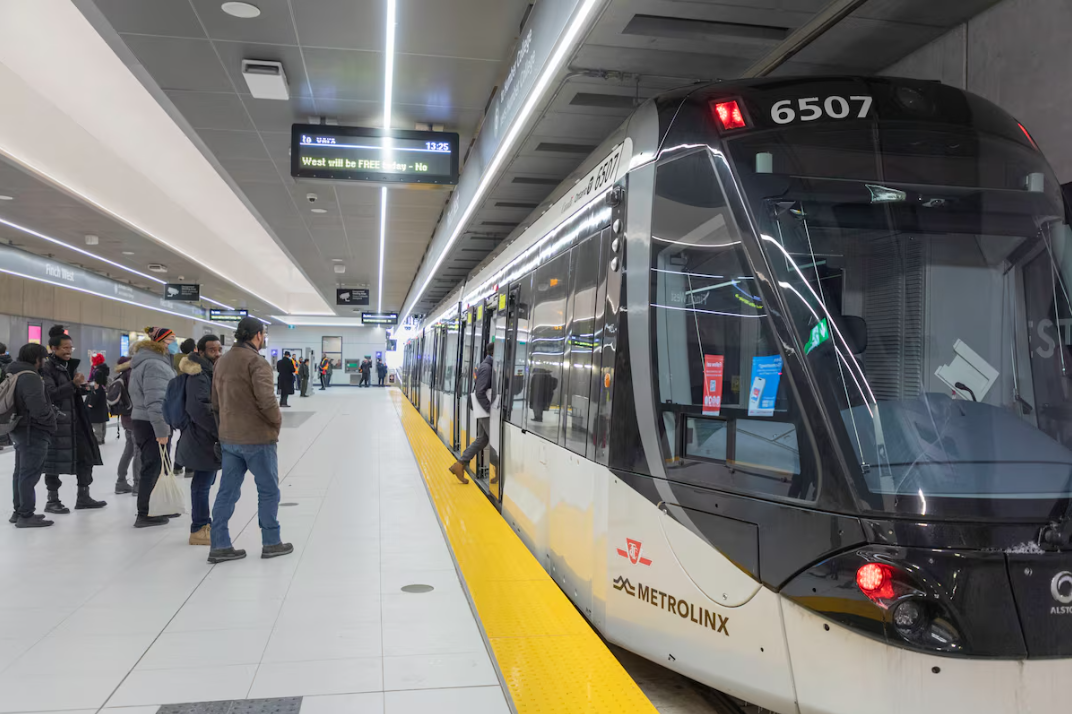
Finch West Line 6 LRT

You are questioning whether these corridors have the ridership to justify LRT, but also suggesting Toronto build subways everywhere like NYC and Tokyo?

I think Wilson-Rexdale-Derry, Lawrence East, and Kingston-Highway 2 are good candidates for future light rail. In 905, there Queen in Brampton. That's pretty much it.

Given Toronto's suburban nature, it's mostly a choice between building LRT or doing nothing. Scarborough ain't Queens, and North York ain't The Bronx.
 
You are questioning whether these corridors have the ridership to justify LRT, but also suggesting Toronto build subways everywhere like NYC and Tokyo?

I think Wilson-Rexdale-Derry, Lawrence East, and Kingston-Highway 2 are good candidates for future light rail. In 905, there Queen in Brampton. That's pretty much it.

Given Toronto's suburban nature, it's mostly a choice between building LRT or doing nothing. Scarborough ain't Queens, and North York ain't The Bronx.

No thanks.
 
I admit, St. Clair is actually better than Line 6, but I didn't want to throw too many caveats in the previous post so as to weaken the point. St. Clair is 2 km from the 'official' downtown, and some would argue it is downtown.

It's my hypothesis that there are no corridors that warrant an upgrade to tram that are also currently wide enough to fit a tram. Unless one or more of the following happens to the corridor: infeasible changes that would violate municipal code and/or zoning by-laws, and/or expropriation.

2024 TTC Daily Bus Boardings:
Finch East (39 + 939) — 43,048
Lawrence West (52 + 952) — 42,077
Dufferin (29 + 929) — 40,750
Finch West (36) — 39,541
Jane (35 + 935) — 37,464
Wilson (96 + 996) — 34,469
Lawrence East (54 + 954) — 33,594
Don Mills (25 + 925) — 32,705
Eglinton West (32) — 32,221
Markham Road (102 + 902) — 31,659
Steeles West (60 + 960) — 30,141
York Mills (95 + 995) — 25,832
Sheppard West (84 + 984) — 23,509
Sheppard East (85 + 985) — 22,490
Steeles East (53 + 953) — 20,859

A few thoughts here.

First, lets pull out from the above those routes that will be subway/metro etc.

Don Mills (25 + 925) — 32,705 - Ontario Line and Ontario Line North Extension

Eglinton West (32) — 32,221 - Eglinton West LRT Extension (fully grade separated); + extension to Pearson.

Sheppard West (84 + 984) — 23,509 - Sheppard Subway
Sheppard East (85 + 985) — 22,490 - Sheppard Subway

Of the remainder:

LRT is not even remotely contemplated for:

Lawrence West, Dufferin, Wilson, York Mills, Lawrence East, Markham Rd, and Finch East

Roads/Routes with LRT discussed, at some level, seriously (not necessarily under active consideration)

Eglinton East (of Kennedy), Kingston Road (Eglinton to Morningside), Morningside, Sheppard East (of McCowan), Jane, Finch West (to Yonge), WWLRT to Dufferin, Finch West to Pearson.

To the perennially pro-LRT crowd I ask: where can we find ROWs wide enough, and with boardings per km high enough to support an upgrade to tram in the City of Toronto?

I am not in the unabashedly pro-LRT crowd, but I'm not in the bash it crowd either. Finch as executed/operated is a fail; but assuming we did it properly, its not an inherently terrible medium.

With that said, I oppose the EELRT as currently contemplated as it has failed several tests I've laid out including faster journey times for riders, and comes at a projected cost so high that is plausible to discuss achieving better outcomes with a combination of BRT and Subway for similar sums.

Of the remainder, EWLRT to Pearson I support, Finch extension I would place on pause until we see how well we remedy the issues on the existing line, WWLRT to Dufferin I support. Jane I haven't modeled out to form a clear opinion on.

I hear people drone on about how great LRTs are, how they definitely wOrK In oThEr cItIeS, while conveniently ignoring cities entirely devoid of them such as New York City and most metro-having cities in Mainland China (34 out of 46 have metro, but no tram). Or nearly entirely devoid of them like Tokyo or London, with 17.2 and 28 km respectively to Toronto's 93.3 km, soon to be 100+ km.

Ok, can we leave the goofy lettering out please, it does not add credibility and it removes readability.

Street ROW widths property line to property line: https://map.toronto.ca/torontomaps/ Feature Filter>Properties>Property Parcel; Measurement

ROW map here:

1768918396183.png


Anything in red can easily support LRT, dark blue may be feasible (St. Clair was) but will likely have more trade-offs.
 
You are questioning whether these corridors have the ridership to justify LRT, but also suggesting Toronto build subways everywhere like NYC and Tokyo?

I think Wilson-Rexdale-Derry, Lawrence East, and Kingston-Highway 2 are good candidates for future light rail. In 905, there Queen in Brampton. That's pretty much it.

Given Toronto's suburban nature, it's mostly a choice between building LRT or doing nothing. Scarborough ain't Queens, and North York ain't The Bronx.

When exactly did I ever say 'build subways everywhere'?? Give me the quote. I've made over close to two dozen posts saying Finch should have gotten tram later in hindsight, and definitely not a subway.

What a wild and pervasive strawman against pro-subway / pro-grade separation people.

It's not really about pro-LRT vs. pro-subway. As I've said earlier: grade separation matters much more for speed and service reliability. It's a romantic notion to expect wide stop spacing and subway speeds on median or roadside trams. Wide spacing would necessitate parallel bus service, which decreases the environmental and economic benefits. Cases like Calgary have large segments that function like the surface and underground sections of the Toronto subway and also run high floor trains.

Rolling stock choice of narrower, shorter consists for tram vs. wider, longer metro, has more to do with operational economics; the decision should be made based on projected transit demand.

Most of these bus corridors do not come close to the daily boardings per km to justify upgrade to tram (even if extrapolating for latent demand), let alone light or heavy metro.

Why no tram in hindsight? Finch West had just over 3,000 daily boardings per km in Fall 2019 when its boardings were 55,000. For reference, Line 1 and 2 are around 16,000 boardings per km in 2025. Finch West is down to 40,000 in 2024. Neither number is high enough to necessitate immediate tram upgrade for 10 km of the route. There are only 3 mid and high-rise developments near Finch West, all in pre-construction. Densification isn't happening anytime soon unfortunately.

I'm still content with Line 6 being built as a learning opportunity and because Toronto always procrastinates on transit, so it's a good thing they built something early for once.

"Given Toronto's suburban nature". Toronto would be the third largest city in Western Europe (population over a similar area), behind only London and Paris. And it certainly isn't smaller than most of those 34 Chinese cities (30 of which you've never heard of) that have only metro. It's only North American-ly suburban in that it has a lot of house-lined, comparatively narrow arterials.

China has very few tram lines due to robust alternative last-mile transport options, intentional urban design, and better economies of scale with metro and much more. People there like walking and China is huge on bike sharing services. Chinese urban arterials are designed with high capacity car lanes in the centre, while cyclists and pedestrians are segregated onto parallel side paths and sidewalks. Arterials in Mainland China are standardized and significantly wider than Toronto arterials (think 40+ metres), both curb-to-curb and property line to property line. In many ways, China has city streets that are much more suited to trams, and yet they do not build them.

So many pro-LRT advocates fallaciously extrapolate that just because X city has half-decent trams, therefore they would work in Toronto. That is a false equivalence. They're treating fundamentally different urban contexts as if they were equivalent.

They are asking for a move away from car-centric design in a place with streets too narrow for fast trams, along with some of the highest car ownership rates in the world. Vast majority of Toronto arterials are no wider than 26 metres property line to property line at their narrowest segments. That will not fit four car lanes, a tram, a meaningful sidewalk and a stop platform. This is a big reason why Line 6 was not built towards Yonge and beyond. The ROW was already much wider west of Keele.

You cannot merely copy and paste fast trams like Calgary CTrain or the Utrecht Sneltram into Toronto, both of which are borne of compromise between low-density suburbs and mid-density downtowns with extensive use of pre-existing railway ROWs, massively wide streets (10 + lanes equivalent, 40+ metres) and wide tracts of land that don't exist in Toronto except for the hydro corridors. I've touched on this before, it's not feasible to run low or high floor trams on previous freight or Metrolinx rail through leasing or acquisition. Any urban rail run on railway ROWs would be metros or RERs like the Ontario Line or Line 1 Yonge extension. And there is little to no difference between high floor trams and metro in the first place.
Anything in red can easily support LRT, dark blue may be feasible (St. Clair was) but will likely have more trade-offs.
@Northern Light As we've discussed on an earlier page, the red cannot easily support tram/LRT, those are planned widths, not actual widths. Steeles is the notable exception. Large segments, if not the majority of York Mills, Finch etc. are listed as 36 metres in the Official Plan but are only 25-26 metres wide property line to property line, which also leads to the issue of setbacks if expropriation is needed. The narrowest sections strongly influence tram retrofit viability, even if the widest parts approach or exceed 30 metres. You can check for yourself for potential LRT corridors on https://map.toronto.ca/torontomaps/ and compare to the Official Plan ROW map https://www.toronto.ca/wp-content/uploads/2017/11/984d-cp-official-plan-Map-03_OP_ROW_AODA.pdf.

Here is an example of a '36' metre ROW section that is more like 20 metres. Even property line to property line doesn't account for geography like deep ditches, ravines, cliffs, and freight ROWs in south Bayview's case, so checking other sources or going there in-person helps. (Of course most trams are not going to climb Bayview's steep grade). The faster street running trams in Europe are usually built on comparatively wide ROWs, sometimes with slip roads. Slip roads are virtually non-existent in Toronto. Previously I've compared Finch to Brussels and Frankfurt, the latter highlighted sections ran on wider public ROWs.

1768922467034.png
1768920872022.png

1768921288990.png
1768921397835.png


For Jane LRT, we can immediately rule out Bloor to Dundas at-grade, the bare minimum is 25 metres property line to property line and that's mid-block with no extra room for tram stops or turning lanes. This is something I forgot to mention previously: For mid-block with split side stops, you need closer to 30 metres minimum, even more with two-way centre platforms and at intersections for extra turning lanes. In these cases there is virtually no boulevard except the 2.1 metre sidewalk on each side. Jane does not get wide enough for tram until briefly near Eglinton Flats, becoming too narrow near Weston and Lawrence again.

(edit: I forgot to account for an extra 2-3 metres construction buffer on each side for street widening. Broadly 3 options: voluntary Temporary Construction Easements, as well as expropriations of a temporary or permanent interests. To rebuild a sidewalk right up against the property line, you would end up with equipment and workers standing on private property. The cost to do this legally would be more expensive than a redesign or reroute to a suitably wider street. Land owners can refuse a TCE, and expropriation compensation can be disputed in court, even after the 2020 Building Transit Faster Act. The true width needed is closer to 29-30 mid-block without stops, 32-33 mid block with stops, and 35-36 metres at intersections with stops and turning lanes)

The Jane LRT is dead. The ROW is not consistently wide enough south of Wilson. I can post screenshots showing the same thing on other potential LRT corridors later.

1768924656891.png
1768924703615.png
 
Last edited:
I find it odd that people correlate Finch West's bad performance with the viability of LRT as a whole. You can argue that it's executed poorly, but to argue that it's not a viable form of transit in the context of Toronto is uninformed.

You are questioning whether these corridors have the ridership to justify LRT, but also suggesting Toronto build subways everywhere like NYC and Tokyo?

I think Wilson-Rexdale-Derry, Lawrence East, and Kingston-Highway 2 are good candidates for future light rail. In 905, there Queen in Brampton. That's pretty much it.

Given Toronto's suburban nature, it's mostly a choice between building LRT or doing nothing. Scarborough ain't Queens, and North York ain't The Bronx.

At the same time this argument is just as shortsighted. While LRT is almost perfect for some streets in the outer Boroughs, to be efficient they need to feed into higher orders of transit.

For example a potential Eglinton East LRT would feed into Guildwood and Eglinton GO stations as well as Kennedy. A potential Lawrence East LRT could feed into an Ontario Line Extension at Don Mills, a potential GO station along the Unionville Sub, and Lawrence East Station along the Line 2 extension.

These different pieces of the puzzle are to work in tandem.

When exactly did I ever say 'build subways everywhere'?? Give me the quote. I've made over close to two dozen posts saying Finch should have gotten tram later in hindsight, and definitely not a subway. What a wild and pervasive strawman against pro-subway / pro-grade separation people. It's not really about pro-LRT vs. pro-subway. As I've said earlier: grade separation matters much more for speed and service reliability. It's a romantic notion to expect wide stop spacing and subway speeds on median or roadside trams. Wide spacing would necessitate parallel bus service, which decreases the environmental benefits. Cases like Calgary have large segments that function like the surface and underground sections of the Toronto subway and also run high floor trains.

Rolling stock choice narrower, shorter consists for tram vs. wider, longer metro, is more about operational economics.

Most of these bus corridors do not come close to the daily boardings per km to justify upgrade to tram (even if extrapolating for latent demand), let alone light or heavy metro.

Why no tram in hindsight? Finch West had just over 3,000 daily boardings per km in Fall 2019 when its boardings were 55,000. For reference, Line 1 and 2 are around 16,000 boardings per km in 2025. Finch West is down to 40,000 in 2024. Neither number is high enough to necessitate immediate tram upgrade for 10 km of the route. There are only 3 mid and high-rise developments near Finch West, all in pre-construction. Densification isn't happening anytime soon unfortunately.

I'm still content with Line 6 being built as a learning opportunity and because Toronto always procrastinates on transit, so it's a good thing they built something early for once.

"Given Toronto's suburban nature". Toronto would be the third largest city in Western Europe (population over a similar area), behind only London and Paris. And it certainly isn't smaller than most of those 34 Chinese cities (30 of which you've never heard of) that have only metro.

China has very few tram lines due to robust alternative last-mile transport options, intentional urban design, and better economies of scale with metro and much more. People there like walking and China is huge on bike sharing services. Chinese urban arterials are designed with high capacity car lanes in the centre, while cyclists and pedestrians are segregated onto parallel side paths and sidewalks. Arterials in Mainland China are standardized and significantly wider than Toronto arterials, both curb-to-curb and property line to property line. In many ways, China has city streets that are much more suited to trams, and yet they do not build them.

So many pro-LRT advocate fallaciously extrapolate that just because X city has half-decent trams, therefore they would work in Toronto. That is a false equivalence. They're treating fundamentally different urban contexts as if they were equivalent.

They are asking for a move away from car-centric design in a place with streets too narrow for fast trams, along with some of the highest car ownership rates in the world. Vast majority of Toronto arterials are no wider than 26 metres at their narrowest segments. That will not fit four car lanes and a tram. This is a big reason why Line 6 was not built towards Yonge and beyond. The ROW was already much wider west of Keele.

You cannot merely copy and paste Calgary CTrain or the Utrecht Sneltram into Toronto, both of which are borne of compromise between low-density suburbs and mid-density downtowns with extensive use of pre-existing railway ROWs, massively wide streets (10 + lanes equivalent, 40+ metres) and wide tracts of land that don't exist in Toronto except for the hydro corridors. I've touched on this before, it's not feasible to run low or high floor trams on previous freight or Metrolinx rail through leasing or acquisition. Any urban rail run on railway ROWs would be metros or RERs like the Ontario Line or Line 1 Yonge extension. And there is little to no difference between high floor trams and metro in the first place.

As we've discussed on an earlier page, the red cannot easily support tram/LRT, those are planned widths, not actual widths. Steeles is the notable exception. Large segments, if not the majority of York Mills, Finch etc. are only 25-26 metres wide. The narrowest sections strongly influence tram retrofit viability. You can check for yourself for potential LRT corridors on https://map.toronto.ca/torontomaps/

When you look at Toronto's geographical history with LRTs, it's obvious that they act as seeds for retail, density and development. Nearly all of Toronto's most notable and culturally rich avenues have or have had LRTs in the past. We replace buses with LRTs not only to increase capacity and speed but as a city building project. They encourage street walls, mixed use communities, and mid-density developments One needs only to glance at the new developments on St Clair or the Golden Mile to understand. It's also notable that Line 5 Eglinton spurred most of its recent residential developments along the in median sections of the route.

Does this mean it will work everywhere? No. But it allows Toronto build its urban fabric outwards into the outer boroughs in a way that's less nodal and most consistent. So they too can have the same liveable, diverse built environments that's usually reserved for the urban elites.
 
Last edited:
When you look at Toronto's geographical history with LRTs, it's obvious that they act as seeds for retail, density and development. Nearly all of Toronto's most notable and culturally rich avenues have or have had LRTs in the past. We replace buses with LRTs not only to increase capacity and speed but as a city building project. They encourage street walls, mixed use communities, and mid-density developments One needs only to glance at the new developments on St Clair or the Golden Mile to understand. It's also notable that Line 5 Eglinton spurred most of its recent residential developments along the in median sections of the route.

Does this mean it will work everywhere? No. But it allows Toronto build its urban fabric outwards into the outer boroughs in a way that's less nodal and most consistent. So they too can have the same liveable, diverse built environments that's usually reserved for the urban elites.
I substantially agree, besides Line 5, which would've spurred development as light metro or anything beyond the existing bus really. Having spent some time looking at the ROW widths in Toronto of the busiest bus corridors, I just don't see future trams outside of 5, 6 and Waterfront being feasible. If pressed forward, would incur the wrath of NIMBYs to the likes we've never seen. The steep grades north of Bloor also preclude northward expansion of the current streetcar network.

I like trams. I prefer trams for shorter trips. I also don't think future trams would be appropriate, much less optimal in the current built form of Toronto. Tearing down large swaths of the city to build wide arterials like China would never happen in Canada.

I don't think you can change the ethos without changing the built form of those suburban streets ultimately.
Therein lies the problem with future trams in Toronto.
 
@Northern Light As we've discussed on an earlier page, the red cannot easily support tram/LRT, those are planned widths, not actual widths. Steeles is the notable exception. Large segments, if not the majority of York Mills, Finch etc. are listed as 36 metres in the Official Plan but are only 25-26 metres wide property line to property line, which also leads to the issue of setbacks if expropriation is needed. The narrowest sections strongly influence tram retrofit viability, even if the widest parts approach or exceed 30 metres. You can check for yourself for potential LRT corridors on https://map.toronto.ca/torontomaps/ and compare to the Official Plan ROW map https://www.toronto.ca/wp-content/uploads/2017/11/984d-cp-official-plan-Map-03_OP_ROW_AODA.pdf. Here is an example of a '36' metre ROW section that is more like 20 metres. Even property line to property line doesn't account for geography like deep ditches, ravines, cliffs, and freight ROWs in south Bayview's case, so checking other sources or going there in-person helps. (Of course most trams are not going to climb Bayview's steep grade). The faster street running trams in Europe are usually built on comparatively wide ROWs, sometimes with slip roads. Previously I've compared Finch to Brussels and Frankfurt, the latter highlighted sections ran on wider public ROWs.
For Jane LRT, we can immediately rule out Bloor to Dundas at-grade, the bare minimum is 25 metres property line to property line and that's mid-block with no extra room for tram stops or turning lanes. This is something I forgot to mention previously. For mid-block with median stops, you need at least 30 metres, even more with centre platforms.

You and I are largely on the same page here, and I get the desire to rebut those who are relentless champions of LRT irrespective of the performance standards, and have done so myself.

However, I do think you're being a bit extreme in the other direction. I would note, we don't really disagree on routes with some decent LRT potential (subject to design and operating improvements vs Finch)

On ROW widths, if we're going get into the nitty gritty, there's no sense here in in going road by road when you and I would largely agree that most of the roads you mentioned simply aren't good candidates for LRT at least in the near to medium term.

But I do want to nitpick your ROW assumptions.

Publicly, I will simply say, I think your assumptions are off (respectfully). I think you are assuming no vehicle lane removals (which is arguably the law today, but we'll come back to that), but which I think is an unreasonable assumption for LRT, especially on six-lane roads, but even on 4-lane.

We might have more open discussion here, though I'm not sure how useful it is, since we largely get to the same place at the end. I just think its good to avoid extremes in statements, and particularly so where the conclusions stated are at the very least open to some debate.

That said, check your messages, momentarily.
 
We might have more open discussion here, though I'm not sure how useful it is, since we largely get to the same place at the end. I just think its good to avoid extremes in statements, and particularly so where the conclusions stated are at the very least open to some debate.
Not sure how more nuanced and open I can be in saying, "It's my hypothesis that there are no corridors that warrant an upgrade to tram that are also currently wide enough to fit a tram." Especially when the empirical evidence I have seen so far supports this hypothesis. I am happy to be proven wrong though. It's definitely possible that I overlooked some future tram-ready corridor that is wide enough besides the aforementioned Steeles. 4+ lane arterials naturally have the highest bus ridership as they already contain the most homes, jobs and destinations. I am thinking 6 lane arterials can and should be cut to 4 lanes for a tram ROW, but unfortunately the vast majority of busy bus corridors are 4 and 5 lanes wide.

Put differently, the maximum width a 5 lane road can be curb-to-curb is 20 metres. 5 lanes x 4 metres = 20 metres. The absolute minimum for a tram according to Metrolinx is 20.6 metres. 7.4 metre median tram + 4 lanes x 3.3 metres = 20.6 metres. Therefore there are no 5 lane roads in Toronto that can fit a tram ROW for all intents and purposes. The bare minimum is 6 lanes without necessitating expensive street widening. For example: most of Kingston Road and Steeles Avenue.

I don't care that much about 'performance standards', I know if the relevant parties get their act together, Line 6 could hit 30-36 minute travel times. I am hopeful. I care about future modal choice. I don't want to see another abomination like the Eglinton Crosstown favoured over a Copenhagen-esque automated light metro.

Too much of the logic behind the fervent support for trams rests on the fact that it's nominally cheaper, and the assumptions that it is first, cost-effective for the price, and second, that it would physically fit in Toronto. I doubt the first assumption based on my assumption of continued population growth necessitating another modal upgrade eventually, and I almost fully reject the second assumption based on evidence of Toronto’s narrow ROWs compared to the minimum space needed to fit a tram.

You need 10 metres for tram ROW and platform, 3.3m x 4 car lanes, 3m for left turn lane, and 4.2 metres for sidewalks (2.1 metres is the minimum for new sidewalks, with limited exceptions). 10+3.3*4+3+4.2=30.4 metres. You also need a 2-3 metre construction buffer on each side for street widening. So 35-36 metres is the minimum required public ROW at intersections. 32-33 metres for stops without turning lanes. 29-30 metres for mid-block cross sections. The vast, vast majority of Toronto arterials do not meet the minimum needed width. And the ones that do, do not have the latent or current transit demand to warrant a modal upgrade. And this is all assuming no bike lanes (compliments of the province).

1768935038735.png

Cross section from Finch EA Exec Summary: https://stevemunro.ca/wp-content/uploads/2019/08/executive_summary.pdf

The continued migration from rural to urban driving population growth in Chinese cities is another driving factor for why they prefer metros over trams. Most large cities have seen their actual population double since 2000 when including 'non-resident' workers. Automated metros are much more futureproof. As seen in many Chinese cases, you can start them running 6 to 10 minute headways peak to off-peak, then tighten it to as low as 90 seconds when ridership grows due to local population growth or surges like Chinese New Year.

That being said, I guess I have to make a disclaimer that I don't think Jane LRT (which ain't gonna happen barring expensive expropriation) should instead be a subway. I am big on downtown subways. Frankly, all of the 16.6 sqkm downtown should be within 1 km of a subway station. That it's not the case despite Toronto having one of the densest downtowns on the planet is unacceptable. The downtown streetcars are a huge bottleneck in mobility downtown. But I guess we're too poor to afford an upgrade. I am also ok with suburban extensions to existing lines so long as trips from the new terminus to downtown do not become unreasonably long i.e. 60 minutes.

One day, the transit demand on Steeles will likely warrant a modal upgrade. Whether the authorities in the far future choose at-grade tram to meet then-current needs, or grade separated tram or metro for better futureproofing, noone knows. Perhaps by then Toronto population growth will be 0 or negative, thereby making it unnecessary to futureproof (like in many parts of Europe today).
 
Last edited:
I maintain a spreadsheet purely for construction costs of major projects. Thankfully, I did track viva, 6, and pretty much all the other HOT projects in the GTA.
I have decided to also include all the other notable LRT projects.

SourceNotesNameCost/km ($, 2025, mil/km)Opening YearLengthCost, YOC, ($, millions)Cost, 2025, ($, millions)
* Mixed traffic segments not inc.Viva Phase 1672020341800 (2017 $)2270
* Mixed traffic segments not inc.Mississauga TW65201710.3528 (2017 $)666
ION58201919868 (2019 $)1095
* Incurred costs taken as of late 2025.6 Finch West267202610.32548 (2022 $)2746
* Incurred costs taken as of late 2025.5 Crosstown5912026199171 (2019 $)11228
* O&M included.
Preliminary.
10 Hurontario319?185742
* Preliminary.ION Cambridge182?173100

Natural caveat that it's pretty difficult to find exact apple to apple numbers for this stuff. It's incredibly easily to only get a portion of the cost, or to get much more of the cost than construction esp. w. MX who for some reason hates to separate O&M with construction.

Some takeaways:
- Though it is apparently possible to build LRT for cheaper than BRT, it seems like ION is a bit of an outlier given ION Cambridge is 3x more expensive.
- Otherwise, assuming ION Cambridge costs, an LRT is about 2.7x more expensive.
- Assuming 6FW costs, an LRT is 4x the cost of a BRT like Viva.
- MX is not involved in ION or ION cambridge, but was in Mississauga TW (Though primarily for the western portion) and Viva phase 1.
For the Finch line (and the others in the same table), you can't use their numbers to calculate cost/km. Check the notes for the table.
 
For the Finch line (and the others in the same table), you can't use their numbers to calculate cost/km. Check the notes for the table.
@TRONto you are misinterpreting that. The initial all in cost was quoted as $2.5 billion with roughly $1.2 billion for construction in 2018. The remainder was for maintenance and operations* over 30 years, financing costs and some other insignificant items incurred before or at opening.

Now that Line 6 is complete and running, the construction (capital) costs are fully paid for on the books, which includes the capital financing costs. The remaining $1.2 billion out of the overbudget $3.7 billion current all in cost is [essentially just] for the 30 year maintenance contract. The non-maintenance side of the contract is >$2.548 billion since that figure was already incurred 2 months before opening. Not exactly surprising for construction costs to double for a P3 project in Ontario (change orders).

*Operations is essentially paid for by the TTC, but without going more in-depth, a small part of 'operations' is handled by Mosaic under the [30 year] contract.
If you're insisting that Line 6 Finch West cost only ~$100 million per km to construct, you are wrong.
 
Last edited:
With that said, I oppose the EELRT as currently contemplated as it has failed several tests I've laid out including faster journey times for riders, and comes at a projected cost so high that is plausible to discuss achieving better outcomes with a combination of BRT and Subway for similar sums.
It seems to be treated as a given that the presence of a LRT enables significantly more development and investment than a BRT.

If even this given manages to apply to the slowest of LRTs, then the only positive I can see in EELRT is that it could initiate a "multi-stage revitalization project that hits four priority neighbourhoods in one" (Eglinton East + Scarborough Village + Kingston-Galloway + Malvern)

Of course, there may be other ways not related to transit to achieve this without spending $4bn+ (but would the private sector also see the incentive to invest?), and you cannot easily predict the long-term health of the economy, so that outcome becomes quite a hypothetical...
(hence why I can't blame Metrolinx for claiming such a wide range in their initial study, that the Finch West+Sheppard East LRTs could lead to an increase in $1.4 to 4.7 bn in land value)

I see that the city has already implemented the Jane Finch Secondary Plan & Keele Finch Plus plans. Where would these areas, especially Jane Finch, have fallen into the peaking order without the Finch West LRT?
The only areas with active studies by the City that don't appear to have transit plans in store appear to be Jane & Wilson, and Malvern.
 
Last edited:
For the Finch line (and the others in the same table), you can't use their numbers to calculate cost/km. Check the notes for the table.
Yes, the total costs are for construction, maintenance, and operation.
The number taken was not the total cost, as is explicitly written in the note, but the incurred costs, aka the costs so far by the end of construction.*
The incurred costs by the opening is when construction is paid out, and maintenance and operation has not yet been paid out or started. Thus, Incurred costs can approximate the cost of construction.
Unless you are arguing that MX is paying for O&M before O&M began, or that MX is paying for construction after construction has finished. (The latter of which you would not, because that would make the costs of const. higher)
@urbanclient has already responded this to you (now twice). I am not sure why you are repeating it, again, without addressing the response.
If you are capable of sourcing a more accurate note that explicitly does not contain O&M, and is recent and up-to-date with cost escalations, I would be more than happy to adjust.

The source you have cited is from 2022, and states total cost of 2.5bn. MX in 2025 says 3.7bn total. Things change, and I am inclined to go with the more recent source.

* Yes the numbers are a few months off opening. I probably lose more accuracy to inflation than I do that, as the dollar sum is just summed of that dollar value, each year, which makes it impossible to properly inflate from one value.
 
Total disgrace.

CITY NEWS:
Posted January 20, 2026 9:31 am.

It was another rough day for transit riders using the Line 6 Finch West due to several issues along the line on Tuesday.
The problems started around 6 a.m. and full service resumed around noon. Shuttle buses were running during the delays and continued to run once service resumed to supplement service.
“Line 6 experienced multiple service challenges during this morning’s rush hour, including frozen switches and disabled light rail vehicles,” a TTC spokesperson said in a update on Tuesday afternoon.
The TTC outlined and explained the issues in the summary below:
Just before 6 a.m., ice buildup on the switch at Martin Grove led to limited access to both platforms at Humber College Station. As a result, service was suspended between Humber College and Martin Grove stations while repairs were taking place. Service on the line resumed around 6:40 a.m.
Around an hour later, a light-rail vehicle lost power near Mount Olive Station. Service was reduced to a single track, which resulted in slower service through the area. Shuttle buses were running between Mount Olive and Martin Grove stations. Service resumed on Line 6 once the stalled train was moved just before noon.
Just after 7 a.m., the TTC said another switch issue was discovered at Milvan Rumike. Service was suspended across the entire line but resumed just after 7:20 a.m.
Then, around 8:20 a.m., another light-rail vehicle stalled eastbound as it was departing Sentinel Station. As a result, service was suspended between Tobermory and Finch West. Riders were transferred onto a TTC bus. Service resumed service just after 10 a.m. once the train was moved.
The TTC said due to the earlier issue at Mount Olive, LRT service on the west end of the line was running at a slower speed. Shuttle buses were in place to supplement service until the issue was cleared after noon.
“During the delays, TTC operations staff were in touch with the contracted maintainer of the line infrastructure (track/switches/signals) and vehicles, Mosaic Transit Group. As you know, the TTC only operates the line so we cannot speak to any maintenance issues. We are offering advice and support as an experienced transit operator for more than 100 years. However, both the TTC and Metrolinx are working jointly under this new partnership model and during this soft opening period,” the TTC said in a statement.
The TTC said starting at 5 a.m., shuttle buses were already on standby at Finch West and Tobermory stations in case Monday’s switch issues at Sentinel Station happened again.
Tuesday’s issues add to a growing list of challenges for the line since it opened in December. Line 6 has experienced multiple outages tied to weather, switch issues and mechanical problems in its first weeks of operation. The TTC has said the line is in a “soft launch” period until the spring and during this time, they are still smoothing out the rough edges.
Last week, the line was shut down at least three times due to weather‑related conditions.
 

Back
Top