News   Jan 09, 2026
 426     0 
News   Jan 09, 2026
 1.8K     1 
News   Jan 09, 2026
 1K     0 

The Future of subway and rapid transit in the GTA

I'll refrain from posting in the Line 5 and Line 6 threads. How is it that Stockholm, a European city of less than 1 million people, can have a metro network more expansive than Toronto's?
Because Stockholm is much much smaller than Toronto, and more dense. Also there are attached urban areas outside of the old city itself. The main urban area is 1.6 million, and still half the size of the city of Toronto.
 
Light rail is proper transit when it's done right and it can be just as fast as a subway line. Your continued insistence on subways subways subways is tiresome and unhelpful.

Whatever or not you think that the way the line was designed was a mistake, shutting it down for years and spending billions to convert it to a slightly different type of line would be an even bigger mistake.
Not that I *edit fully disagree* with the statement: "light rail can be just as fast as a subway" technically....

Just out of curiosity, have you ever been on a subway and tram/LRT in the same city, outside of Canada and the USA?

*sorry typo
 
Last edited:
Not that I fully agree with the statement: "light rail can be just as fast as a subway" technically....
And yet the light rail system in Montreal is faster than the subway. Even the old light rail line from Toronto to Guelph in the 1920s was faster than the subway is now.

Because it's irrelevant how it's branded, or if the capacity is light rail, intermediate rail, or heavy rail. It's all about stop spacing and whether it's grade separated or not.

I believe that's been mentioned more than once here - I feel you aren't paying attention.
 
And yet the light rail system in Montreal is faster than the subway. Even the old light rail line from Toronto to Guelph in the 1920s was faster than the subway is now.

Because it's irrelevant how it's branded, or if the capacity is light rail, intermediate rail, or heavy rail. It's all about stop spacing and whether it's grade separated or not.

I believe that's been mentioned more than once here - I feel you aren't paying attention.
Montreal's REM runs full-blown metro rolling stock from the Alstom Metropolis family at 2.94 metres wide. Alstom Metropolis is decidedly not a light metro rolling stock family. https://en.wikipedia.org/wiki/Alstom_Metropolis

Similarly if Ontario Line trains do end up being 3.0 metres wide and 80 metres long, that would be full metro rolling stock, not light metro. The only thing that might, might make it light metro is that REM runs with 2 and 4 car trainsets, ~40 to 80 metre trains.

Even then, Paris is usually not considered a light metro, but can run rolling stock as short as 45 metres and most Paris rolling stock is no wider than 2.45 metres. Point is, there are plenty of metro systems out there running ≤2.8 metre wide rolling stock with ~80 metre trains that are not considered light metro.

I never thought the REM was light rail or even light metro, nor did I believe in the CDPQ's marketing. Also some media outlets very erroneously called the REM "light rail". That doesn't change what it actually is.
[...]this debate is pointless and indicates ignorance of not just foreign terminology, but what a metro/subway even is. If people here actually put in the time to look into what these transit mode terms actually mean beyond just skimming, there wouldn't be these pointless "uMmM aCkTuaLY Line 6 uses LRVs so it must be an LRT" debates.

The Ontario Line will run with 3 metre wide, high floor trains. That alone makes it a full metro, rather than light metro or the North American tram "LRT". Only rolling stock with widths below 2.8 metres could be called light metro, and even then Montreal and Paris are notable exceptions. The Calgary and Edmonton systems that run on dedicated ROWs for portions would be analogous to Paris' tram-trains. Line 6 and the streetcars would be called trams in Europe (and the rest of the world).

"LRT" outside of Asia, is just a made-up North American term because apparently we didn't want to use the word "tram". LRTs just means light metro in Asia because "light rail" is the best translation of "light metro" in many Asian languages. Metro is short for metropolitan railway, and nobody literally calls it a "metropolitan" railway in Asia.

There are just two modes of local rail transit nowadays: metros and trams, everything else can be considered a variation of those two. And virtually noone is thinking of the distinction between metro and light metro besides forum dwellers. The older Beijing airport line technically uses light metro Innovia ART 200 rolling stock, but nobody goes around calling it "light" anything. It's just an express metro line that happens to serve the airport. For people in Copenhagen, their light metro system is just the "metro". If it ain't a metro, it's a tram. A stadtbahn is just an upgraded tram line, if upgraded at all. An LRT is just a tram line.
 
Last edited:
Because Stockholm is much much smaller than Toronto, and more dense. Also there are attached urban areas outside of the old city itself. The main urban area is 1.6 million, and still half the size of the city of Toronto.
Stockholm is not denser than Toronto.

Toronto is denser than Stockholm.

Whether it be peak densities downtown or comparing Toronto city proper to Stockholm's urban area etc... etc...

Stockholm is just a less dense, smaller city, with a longer subway system, with higher annual ridership in 2019 compared to Toronto.
TTC subway 2019 ridership: 426 million
Stockholm metro 2019 ridership: 462 million

Toronto: 630 sqkm, 3.3 million people, ~5,200 people per sqkm
Stockholm: 382 sqkm, 1.62 million people, ~4,200 people per sqkm

GTA: 7,100 sqkm, 7.7 million people
Stockholm Metro Area: 6,519 sqkm, 2.5 million people

Toronto proper of 630 sqkm has more people than the wider Stockholm metropolitan area of 6,519 sqkm. @Bojaxs ignore the confidently wrong, low to 0 due diligence crowd.

***EDIT***
Old Toronto (~97 sqkm) has a similar population as Stockholm city proper (188 sqkm), but only half the land area.
Source: Post-Amalgamation Impact on Developing Land-Use Planning Policy A Case Study of Ontario Municipalities JOHN MELIGRANA
https://uplopen.com/books/2191/files/aae6a76c-baba-4634-8370-63fb3b693e5a.pdf

And that's going off undercounted 2021 Census numbers, which even StatsCanada admitted were much lower than reality. Note the difference between 2021 Census population figures for the City of Toronto vs. 2020 and 2021 StatsCanada estimates.
 
Last edited:
🤣 Stockholm is not denser than Toronto.

Toronto is denser than Stockholml
Only if you cherry pick the data.

You said Stockholm was less than a million people (which is correct). But then you choose a larger area, which includes Stockholm and elsewhere, and prove that is less dense than Toronto. But you use a population much more than a million?

Please stop gaslighting us.
 
Only if you cherry pick the data.

You said Stockholm was less than a million people (which is correct). But then you choose a larger area, which includes Stockholm and elsewhere, and prove that is less dense than Toronto. But you use a population much more than a million?

Please stop gaslighting us.

Who is "you"? I can't speak for @Bojaxs , but I am pretty sure they were being rhetorical about it, exaggerating it a bit for effect. I myself never previously said Stockholm was a city of 1 million even though Stockholm city proper does technically have a population of ~1 million. Noone here takes other's speech so literally as you, but then fails to hold themselves to their own standards. You confidently claimed Stockholm was denser than Toronto without a single shred of evidence. Whether you compare CBDs, downtown high-rise densities, analogous areas in the 100s or 1,000s of sqkm, Toronto is consistently and clearly the denser city. It's not even close.

It's clear that the only way to make Stockholm a denser city than Toronto in some way for some specific geographic part is to do bad faith cherry picking, the complete opposite of what @nfitz is saying. Same sh**, different day with this humbug.

You have trouble with reading comprehension and anger management to say the least. Is it really surprising so many people have you on ignore?
I'll refrain from posting in the Line 5 and Line 6 threads. How is it that Stockholm, a European city of less than 1 million people, can have a metro network more expansive than Toronto's?

At some point we're going to have to convert Line 5 to a Metro. Preferably to Ontario Line standards. That way the rolling stock can be interoperable between Line 5 & 3.

A lot of the pro-LRT folks would probably argue that the stations for the Stockholm Metro are overbuilt for the amount of passengers they carry. I'm getting a lot of Sheppard line vibes from the first video I posted, and I love it. Large, expansive platforms and quiet.


Last edited:
And yet the light rail system in Montreal is faster than the subway. Even the old light rail line from Toronto to Guelph in the 1920s was faster than the subway is now.

Because it's irrelevant how it's branded, or if the capacity is light rail, intermediate rail, or heavy rail. It's all about stop spacing and whether it's grade separated or not.

I believe that's been mentioned more than once here - I feel you aren't paying attention.
REM is not LRT despite what the locals call it. Or, at least not what is considered LRT in the Toronto context. To me LRT is typically low floor LRVs operating in a non-grade separated right of way. It could have wider stop spacing, but the lack of grade separation limits speed and limits the possibility of automated train operation. Running fully automated metro rolling stock on fully-grade separated ROW is something categorically not LRT. You can debate whether it is a separate thing than subway/heavy rail metro, like light metro.
 
I have no intention of involving myself into a catfight, but what I will say is seeing that Stockholm supposedly had a lower density than Toronto failed the eye test having living there, especially given the prevalence of those Million Programme suburbs.

I see that Stockholm Municipality has a density of ~5,300/km, so actually just a touch above Toronto's on the average. If you were to compare Old Toronto to the "core" areas of Stockholm then I would imagine Old Toronto would naturally win.
What I would also note is that quite a bit of Stockholm's land is dedicated to large green spaces (i.e. out of the 3,577ha of Stockholm, 766ha are part of the Universitetet & Djurgarden districts which are primarily large continuous parks and forests!) - so if you were to exclude large parks and ravines from both cities, then this gap between the two would increase a bit. But not enough for say a substantially meaningful, say 2x, difference.

You might have been referring to the broader metro area to get to the 1.6M number, which includes the outlying municipalities like Sollentuna which generally are lower-density, and are on the borderlines of rurality in some cases.

Comparing the areas covered by cities as a proxy for density theoretically is a good path for apples-to-apples comparison, but often it is more apple-to-oranges given you are reliant on quite arbitrary borders where logic may differ between places. The biggest offender of this, to my understanding, would be the cities in China where you see the top-line stat of >1M population, but look at the borders of them, and see that they cover massive swaths of land, and realize actually the "main city" within that city may only have a population of <500K.

(One final reflection of Stockholm is that when entering a T-bana/Pendeltag station, by the fare gates, there would always be live timetables that allowed me to determine if I should run down to the platform if a train was arriving shortly. I wish this was tablestakes in Toronto, and the only time I've seen this here, would actually be at the beginning of the Line 1 to 6 connection at Finch West.)
 
Last edited:
  • Like
Reactions: PL1
I have no intention of involving myself into a catfight, but what I will say is seeing that Stockholm supposedly had a lower density than Toronto failed the eye test having living there, especially given the prevalence of those Million Programme suburbs.

I see that Stockholm Municipality has a density of ~5,300/km, so actually just a touch above Toronto's on the average.
What I would also note is that quite a bit of Stockholm's land is dedicated to large green spaces (i.e. out of the 3,577ha of Stockholm, 766ha are part of the Universitetet & Djurgarden districts which are primarily very large parks and forests!) - so if you were to exclude large parks and ravines from both cities, then this gap between the two would increase a bit. But not enough for say a substantially meaningful, say 2x, difference.

You might have been referring to the broader metro area to get to the 1.6M number, which includes the outlying municipalities like Sollentuna which generally are lower-density, and are on the borderlines of rurality in some cases.

Comparing the areas covered by cities as a proxy for density theoretically is a good path for apples-to-apples comparison, but often it is more apple-to-oranges given you are reliant on quite arbitrary borders where logic may differ between places. The biggest offender of this, to my understanding, would be the cities in China where you see the top-line stat of >1M population, but look at the borders of them, and see that they cover massive swaths of land.
Old Toronto (~97 sqkm) has close to the same population as Stockholm city proper (188 sqkm), but around half the land area.
Source: Post-Amalgamation Impact on Developing Land-Use Planning Policy A Case Study of Ontario Municipalities JOHN MELIGRANA
https://uplopen.com/books/2191/files/aae6a76c-baba-4634-8370-63fb3b693e5a.pdf

And that's going off undercounted 2021 Census numbers, which even StatsCanada admitted were much lower than reality. Note the difference between 2021 Census population figures for the City of Toronto vs. 2020 and 2021 StatsCanada estimates.

Similarly, Old Toronto and East York also have a similar population as Stockholm city proper, but are only 110 sqkm vs. 188 sqkm.

What you are seeing with the eye test is probably you spending a lot of time in mid-rise density, maybe with narrower streets etc... Different urban morphology. But not an apples to apples comparison. And not a very typical comparison when one considers that comparisons are usually done with similar areas radiating outwards from a city's centre. By conventional metrics, at every step you go, Toronto is the denser city. 16.6 sqkm downtown, ~97 sqkm Old Toronto, 630sqkm city proper, ~1,800 sqkm urban area... etc... etc....

Toronto's downtown, official 16.6 sqkm or otherwise, is extremely dense. Old Toronto and Old Toronto+East York is naturally skewed to be very dense as a result.
 
Last edited:
REM is not LRT despite what the locals call it. Or, at least not what is considered LRT in the Toronto context. To me LRT is typically low floor LRVs operating in a non-grade separated right of way. It could have wider stop spacing, but the lack of grade separation limits speed and limits the possibility of automated train operation. Running fully automated metro rolling stock on fully-grade separated ROW is something categorically not LRT. You can debate whether it is a separate thing than subway/heavy rail metro, like light metro.
My main point is that it's entirely dependent on what the system actually is, not the branding or capacity.

The premise was that light rail is nevert faster than (intermediate? or) heavy rail. And that premise is false.


(One final reflection of Stockholm is that when entering a T-bana/Pendeltag station, by the fare gates, there would always be live timetables that allowed me to determine if I should run down to the platform if a train was arriving shortly. I wish this was tablestakes in Toronto, and the only time I've seen this here, would actually be at the beginning of the Line 1 to 6 connection at Finch West.)
I've certainly done this changing from one GO train to another GO train (or UP) at Union. And we are starting to see more useful screens as one enters the subway stations - though how the wind is blowing is normally a dead give-away.
 
Not that I *edit fully disagree* with the statement: "light rail can be just as fast as a subway" technically....

Just out of curiosity, have you ever been on a subway and tram/LRT in the same city, outside of Canada and the USA?

*sorry typo
Not just technically but in practice. There are LRT systems that have higher top speeds and average speeds than our subway. And they don't even need to be fully grade separated to do it. I'm curious why your question has so many qualifiers. An LRT/tram being in a city without a metro or north of Mexico doesn't change my point.
 
Not just technically but in practice. There are LRT systems that have higher top speeds and average speeds than our subway. And they don't even need to be fully grade separated to do it. I'm curious why your question has so many qualifiers. An LRT/tram being in a city without a metro or north of Mexico doesn't change my point.
Please correct me if I am wrong:

I'm aware of some, just not many. Trams and the like averaging ≥30 km/h stop to stop speeds seems to be a rarity. I assume even moreso when a city has both metro and tram since they tend to fill different roles.

I was trying to figure out what their firsthand experiences were with fast trams, because the impression I get on UrbanToronto is that some, not all, have hardly left the North American continent. As such, some views on transit appear to be NA-centric.

Technically, some trams can hit subway average speeds, blurring the line between the two. But as far as I know Calgary C-Train-like speeds are virtually unheard of outside North America, outside of Baltimore, LA, Salt Lake, Edmonton, Dallas.

There are stadtbahns in Germany that are 30 km/h +/- a few km/h, and Bergen in Norway, but I doubt many Urban Toronto posters have been on these systems. Your typical tram in say Berlin or Moscow is not going to hit those speeds. If they were to hit those speeds, then the trams would have large stretches of dedicated ROWs, some in tunnels, some re-using old railway ROWs, which is not realistic for Toronto. At that point, Toronto would likely build a subway or keep the ROW for GO trains instead. Case in point Ontario Line and Yonge North extension. So I mostly disagree with this: "And they don't even need to be fully grade separated to do it." Actually AFAIK any trams hitting faster than subway speeds have a lot of grade separation. Maybe not fully grade separated for the whole length of the line, sure.

A street-running tram is definitely not going to hit subway speeds. And since Toronto's not going to turn a CN/CP/GO ROW into a tram-train like Paris, if we were to elevate or tunnel just for a tram, we might as well build a light metro, as is the case for modern systems in many cities.

Bergen is a very small city in a very wealthy country. AFAIK it is the only non-North American city to build a subway-speed tram in the 21st century that did not mostly consist of a pre-existing dedicated ROW. The 5 German Stadtbahns that approach subway average speeds are legacy systems initially built 35 to 50 years ago.

Modern automated metro is the way to go for a city the size of Toronto. It's not likely that Metrolinx would pigeonhole a tram into a dedicated ROW like Eglinton again... right? Right?

Dear GMetrolinx, please no...

Stadtbahn average speeds (speeds vary depending on source): https://www.netzsieger.de/ratgeber/der-grosse-geschwindigkeits-index
 
Last edited:
IIRC, in RMTransit's video on Frankfurt, he explicitly mentions that its Stadtbahn* was a direct inspiration for Calgary (and Edmonton). One example from the city's N-S axis:
  • Dornbusch - Sandelmuhle, after the N-S line exits its underground tunnel in the city's core; the trains run in the centre of the city's main N-S street (Eschersheimer Landstrasse), thus comparable to Eglinton and Finch. ~3.5km, 9 minutes, 6 stops ~= 22km/h. This is with generous stop spacing, so if you were to remove some stops then I would imagine this would approach 30, so it shows there is a pathway to get near these numbers without grade-separation or tunneling. Given how Frankfurt is more compact, there isn't any pressure at all to sacrifice accessibility for speed. I never had any complaints getting from Hauptwache to Kalbach in ~20 minutes which was near the "border" of the city.
    • This section was supposed to be originally tunneled, like the southern portions of the line, but wasn't because the city didn't have the money to do so. There is no push by anyone to tunnel this section because there is not really any realizable ROI (beyond saving the deaths of 1-2 people/yr who will come into contact with the train. The main consequence of not tunneling this section is that it really divides the neighbourhoods it crosses in two. The last time I was on Finch near Milvan Rumbie, there were 2 people that jaywalked across the road. While less likely given the lower frequencies, I fear that eventually there will be a crosser who gets hit by a train that will rollback whatever progress is made on speed.)​
  • Sandelmuhle - Gonzenheim (Bad Homburg); no longer on the centre of the street (mainly on the sides as the train exits the "city" and moves through the greenbelt towards the surrounding towns), ~8km, 12 minutes, 6 stops ~= 40km/h
Frankfurt also has a situation comparable to Eglinton - which is the ~2.7km U5 expansion into the new(er) district that is the Europaviertel (planning to provide ~30K jobs + ~4K housing units), which is just west of the Hbf. The investors wanted an underground line throughout the district, and used the Eschersheimer example above of dividing a neighbourhood in half as their case for why, but the federal and state gov'ts viewed this as too expensive and refused to fund the project. The result was a half-and-half compromise. Issues e.g. tunnel boring, bomb fragments, have resulted in the start date projected to be in 2029, versus the originally intended date of 2022. That might actually make Eglinton look good in comparison!

I would imagine there are lots of lessons from (East) Berlin that are applicable on how best to deal with our reality (but I don't know too much here). Since the DDR essentially had to do Transit City en masse to enable the development of housing given their financial situation (also in other cities e.g. Halle-Neustadt). What seems to be the trend is average speeds of ~17-20km/h with stop spacing generally of ~600-700m. Again, with these numbers, you can argue that there is a plausible pathway to near 30 with larger stop spacing. Albeit I believe planners view the impact of a LRT stop as being a 500m radius, so too far spacing might dilute the development / land value benefits it would give.

Stadtbahns are also comparable history-wise, given the German cities that pursued this wanted U-Bahns but couldn't afford them. So the Stadtbahn was the middle ground that could potentially be converted down the line, but they've largely all given up on this dream. So while I agree that a conversion would be great to serve the future needs of the Golden Mile, history would tell us that all you need are one or two large recessions for that idea to probably evaporate from the mainstream for a half-century (assuming government fiscal accountability returns to fashion).

I believe you can argue that Seville and Malaga's systems are also new faster "light rail" of the 21st century. These are comparable to Eglinton Crosstown, since while primarily/all underground, they use low-floor tram vehicles. I really liked Tampere's LRT system but it seemed to be more comparable to Waterloo rather than being subway speed.

*The distinction between an U-Bahn and a tram in Frankfurt appears to be high-floor vs low-floor vehicles rather than their level of grade separation. There is a brief part of U5 where its tracks share traffic with cars.
 
Last edited:
IIRC, in RMTransit's video on Frankfurt, he explicitly mentions that its Stadtbahn* was a direct inspiration for Calgary (and Edmonton). One example from the city's N-S axis:
  • Dornbusch - Sandelmuhle, after the N-S line exits its underground tunnel in the city's core; the trains run in the centre of the city's main N-S street (Eschersheimer Landstrasse), thus comparable to Eglinton and Finch. ~3.5km, 9 minutes, 6 stops ~= 22km/h. This is with generous stop spacing, so if you were to remove some stops then I would imagine this would approach 30, so it shows there is a pathway to get near these numbers without grade-separation or tunneling. Given how Frankfurt is more compact, there isn't any pressure at all to sacrifice accessibility for speed. I never had any complaints getting from Hauptwache to Kalbach in ~20 minutes which was near the "border" of the city.
    • This section was supposed to be originally tunneled, like the southern portions of the line, but wasn't because the city didn't have the money to do so. There is no push by anyone to tunnel this section because there is not really any realizable ROI (beyond saving the deaths of 1-2 people/yr who will come into contact with the train. The main consequence of not tunneling this section is that it really divides the neighbourhoods it crosses in two. The last time I was on Finch near Milvan Rumbie, there were 2 people that jaywalked across the road. While less likely given the lower frequencies, I fear that eventually there will be a crosser who gets hit by a train that will rollback whatever progress is made on speed.)​
  • Sandelmuhle - Gonzenheim (Bad Homburg); no longer on the centre of the street (mainly on the sides as the train exits the "city" and moves through the greenbelt towards the surrounding towns), ~8km, 12 minutes, 6 stops ~= 40km/h
Frankfurt also has a situation comparable to Eglinton - which is the ~2.7km U5 expansion into the new(er) district that is the Europaviertel (planning to provide ~30K jobs + ~4K housing units), which is just west of the Hbf. The investors wanted an underground line throughout the district, and used the Eschersheimer example above of dividing a neighbourhood in half as their case for why, but the federal and state gov'ts viewed this as too expensive and refused to fund the project. The result was a half-and-half compromise. Issues e.g. tunnel boring, bomb fragments, have resulted in the start date projected to be in 2029, versus the originally intended date of 2022. That might actually make Eglinton look good in comparison!

I would imagine there are lots of lessons from (East) Berlin that are applicable on how best to deal with our reality (but I don't know too much here). Since the DDR essentially had to do Transit City en masse to enable the development of housing given their financial situation (also in other cities e.g. Halle-Neustadt). What seems to be the trend is average speeds of ~17-20km/h with stop spacing generally of ~600-700m. Again, with these numbers, you can argue that there is a plausible pathway to near 30 with larger stop spacing. Albeit I believe planners view the impact of a LRT stop as being a 500m radius, so too far spacing might dilute the development / land value benefits it would give.

Stadtbahns are also comparable history-wise, given the German cities that pursued this wanted U-Bahns but couldn't afford them. So the Stadtbahn was the middle ground that could potentially be converted down the line, but they've largely all given up on this dream. So while I agree that a conversion would be great to serve the future needs of the Golden Mile, history would tell us that all you need are one or two large recessions for that idea to probably evaporate from the mainstream for a half-century (assuming government fiscal accountability returns to fashion).

I believe you can argue that Seville and Malaga's systems are also new faster "light rail" of the 21st century. These are comparable to Eglinton Crosstown, since while primarily/all underground, they use low-floor tram vehicles. I really liked Tampere's LRT system but it seemed to be more comparable to Waterloo rather than being subway speed.

*The distinction between an U-Bahn and a tram in Frankfurt appears to be high-floor vs low-floor vehicles rather than their level of grade separation. There is a brief part of U5 where its tracks share traffic with cars.
The examples you gave are interesting and I wasn't aware of the Malaga metro.

Seville is a unique case because some of its rolling stock is second hand from Sydney and Seville trams for maximum cost savings; and yet they have full platform screen doors at every station.

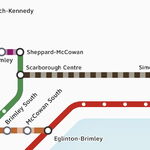
Frankfurt's U-Bahn is generally accepted to be more of a stadtbahn, so an upgraded tram network IMO, and separate from the Frankfurt am Main (slow) tram network. Nonetheless, the site I linked follows the nominal label, classifying Frankfurt as a U-Bahn (see screenshot below).

Given the population size, density, distribution and urban morphology etc, I don't see a rational transit authority willingly designing another mixed-grade stadtbahn-like "LRT" line in Toronto. Seville is a small city running 30 metre trams with full PSDs mostly underground. I don't see Toronto doing that with one or two 30 metre long streetcars again.

Once you get to around 80 metre trains or longer, the clear choice is metro IMO. Ottawa's near 100 metre long trains on a fully grade separated line are ridiculous (two Line 6 Finch West trains connected). Most of the largest Western European cities run some of their metro lines with 80 metre trains or shorter (full metro, not light metro). At that point the benefits do not outweigh the costs if they were to run low or high-floor trams. Not to mention if Metrolinx and the TTC weren't kafkaesque hypocrites about safety, they would pick metro over tram for off-the-shelf integration with platform screen doors.

1767285197853.png

E.g. London, Paris, Berlin, Madrid, Milan have metro trains 80 metres or shorter.
 
Last edited:

Back
Top