News   Dec 23, 2025
 556     3 
News   Dec 23, 2025
 1.3K     1 
News   Dec 23, 2025
 2.1K     1 

Finch West Line 6 LRT

Transit City had no mention of Relief Line. The plan was Don Mills on-street from Sheppard (Finch?) to Eglinton and continue on-street to Pape Station.
(I don't recall, but I think Don Mills - Eglinton was an on-street stop, with the ECLRT station underground. I also don't recall Pape).
There was no plans to extend this southwards - either physically or from passenger capacity point of view. The plan was to dump everyone onto B-D, and then have everyone transfer at Y-B.
The relief line was not part of Transit City, and Transit City was not some all encompassing exclusive plan, the DRL was proceeding separately and did until Doug stopped it for the Ontario Line.

The EA for the Don Mills LRT was never completed, so detailed plans for the line were never finalized, but it would have been concluded eventually that south of Eglinton should be part of the DRL.
 
To be fair, there are also bus doors that require you to wave to open.
The biggest issue is that when it's actually cold outside the doors open so frequently that it never warns up. Today was zero degrees. Imagine riding it when it's -15 with a -25 windchill?
As an aside, Paris metro trains often can be opened well before they fully stop. It's quite possible to jump off a moving train. Imagine the pearl clutching on Toronto news.

New passenger-operated subway doors mean more comfortable temperatures, but are they safe? Transit safety experts say no.
*Cue old U of T prof saying exactly what the news wants them to say.*
Are you saying that someone can get injured by opening the door before the LRT comes to a stop if they press the button?
 
I agree that people should have to use the buttons to open the doors on line 6, but also on the legacy streetcars. And I'd like to see some sort of a lock-out after some time (20s-30s?) after which pressing the outside button will no longer open the door.
As far as I'm aware, this already exists, but it has to be triggered by the driver, and the TTC wants them to not do it, because, you guessed it, safety.

1766506282478.png
 
This is some fascinating revisionism, bordering on propaganda. Especially the part about flipping Ford's concerns over LRTs slowing down traffic... yes, of course he looks good, if you completely change the entire basis on which he made his arguments!

Ford wasn't some progressive, forward thinking revolutionary who was concerned about the amount of time transit riders have to waste. He was part of the suburban, anti-transit, car owning, decision-making class who didn't like having to stop behind the streetcars, and therefore advocated for subway expansion, because subways are underground and therefore wouldn't slow him down. This is obviously an incredibly selfish and myopic viewpoint, so he framed it instead by constructing - yes, constructing, no one is giving the suburbs the shaft except for themselves - a made up downtown vs suburbs culture war, flying in the face of all known common sense and logic from around the world up to that point, suggesting that a dense downtown area deserves the same forms of high capacity transit developed for dense urban areas as sprawling suburbs with considerably less density. And a lot of otherwise intelligent and well educated people fell for this, and continue to lionize him as though he wasn't the political equivalent of a racist MAGA uncle making angry comments under Facebook posts.

It's very quaint, also, to dismiss experiences from Europe as "recollections of a Euro vacation spent riding trams". That's a pretty facile view point, one that could easily be reframed as (many, not all) Torontonians being too arrogant to accept the fact that some places do things better than we do, and we can learn from them. Funny how no one calls shenanigans when people bring up public realm refreshing, pedestrianization, or bike lanes, but when it comes to LRT that's where we draw the line and frame it as though people were riding some tourist pseudo-trolley in some mid-sized American town when they talk about their experiences in Europe.
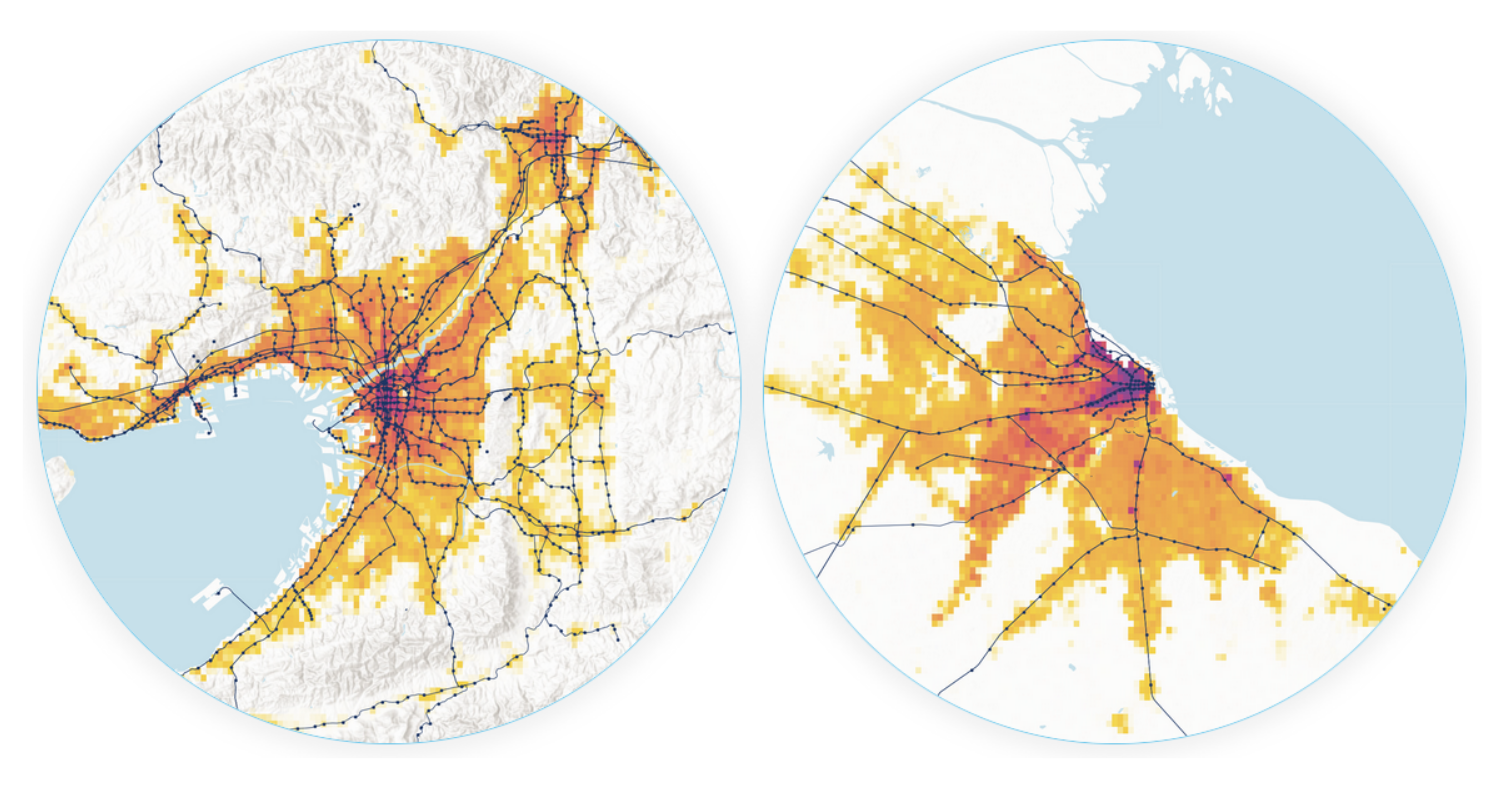
Incoming pro-LRT comments. Even if Ford(s) were/are doofuses, it doesn't mean their conclusions against surface trams were wrong, even if the reasons behind said conclusion were wrong as you pointed out. Even a broken clock is right twice a day. And to the system justification pro-LRT crowd, I ask, do you know about the significant differences in urban morphology and settlement patterns between Western Europe and North America? There are a multitude of factors why trams are cost effective and well-suited to European streets as opposed to North American stroads. Some of those factors cannot be replicated within a lifetime in Canada, much less in the 10-15 year horizon for the next transit project. Reshaping our urban fabric would be a multi-generational endeavour that far outlasts the construction of Toronto’s next 30 skyscrapers built by 2030. That is assuming you get past the NIMBYs and NIMBY politicians on all levels.

Meaningfully altering Toronto’s settlement patterns for a lot more middle density may not ever happen due to the exorbitant short term costs and lack of existing transit. See comparison tool below to better understand how different European tram cities are compared to Toronto.

 
As far as I'm aware, this already exists, but it has to be triggered by the driver, and the TTC wants them to not do it, because, you guessed it, safety.

View attachment 704604
honestly TTC operations are way out of whack here... they want to operate the LRT both as a streetcar when it comes to signalling and as full heavy underground metro for door operation.
they have zero awareness of what happens as a norm outside of the gta let alone overseas...
 
The relief line was not part of Transit City, and Transit City was not some all encompassing exclusive plan, the DRL was proceeding separately and did until Doug stopped it for the Ontario Line.

The EA for the Don Mills LRT was never completed, so detailed plans for the line were never finalized, but it would have been concluded eventually that south of Eglinton should be part of the DRL.
Yes this is what happened. Prior to Transit City's cancellation the DMLRT only made it far enough along that we had a potential stop list and the alignments on Don Mills Ave and Overlea Blvd had solidified. However the issue of how the route would connect to Line 2 had not been solved as the roads in East York are to narrow to support a median ROW. This was exacerbated after the plan was changed from an expansion of the streetcar network to separate larger LRT's since now the route would be fully incompatible with the streetcar network and thus eliminated both a possible Broadview Station alignment as well as a possible extension south into downtown. If it's not going to go downtown then it can't act as a relief line nor did it have the capacity to be one even if it did so the debate on Don Mills shifted back to the DRL since it could both serve the Don Mills corridor as well as run into downtown to be a real relief line. This holds true to this day with the OL, only this time we are building it all the way to Eglinton which was supposed to be part of a Phase 2 project for the DRL. I think we can all agree that of all of the Transit City lines the Don Mills LRT was the most flawed and is better served by the DRL/OL. You can make cases for and against the other lines but when examining all the facts the DMLRT is the hardest to justify considering the alternative already on the table and the overall needs of the city. I say that even as someone who is pro-LRT but the DRL/OL is the better project in this case when you look at it from a macro level. Subways and LRT's have their place and just like I think an LRT on Finch West is fine, an LRT on the Don Mills/DRL corridor is not and its better suited for a subway/light-metro.
 
Last edited:
Incoming pro-LRT comments. Even if Ford(s) were/are doofuses, it doesn't mean their conclusions against surface trams were wrong, even if the reasons behind said conclusion were wrong as you pointed out. Even a broken clock is right twice a day. And to the system justification pro-LRT crowd, I ask, do you know about the significant differences in urban morphology and settlement patterns between Western Europe and North America? There are a multitude of factors why trams are cost effective and well-suited to European streets as opposed to North American stroads. Some of those factors cannot be replicated within a lifetime in Canada, much less in the 10-15 year horizon for the next transit project. Reshaping our urban fabric would be a multi-generational endeavour that far outlasts the construction of Toronto’s next 30 skyscrapers built by 2030. That is assuming you get past the NIMBYs and NIMBY politicians on all levels.

Meaningfully altering Toronto’s settlement patterns for a lot more middle density may not ever happen due to the exorbitant short term costs and lack of existing transit. See comparison tool below to better understand how different European tram cities are compared to Toronto.

I haven't studied many western European transit systems, and I won't pretend to be an expert on them, nor will I claim that there aren't cities in western Europe which we cannot emulate. But what exactly makes the outer boroughs (NOT downtown) of a city like Prague, different than Toronto's suburbs?

Scarborough has a density of 3356/sq km
Etobicoke has a density of 3035/sq km
North York has a density of 3864/sq km

Compare that to the following outer boroughs of Prague that heavily rely, or, in some cases such as Vršovice, Řepy, or Střešovice, exclusively, on trams:

Braník (4040/sq km)
Břevnov (4920/sq km)
Dejvice (3170/sq km)
Hlubočepy (3870/sq km)
Holešovice (8030/sq km)
Kobylisy (8370/sq km)
Libeň (4900/sq km)
Modřany (4370/sq km)
Řepy (6890/sq km)
Strašnice (6090/sq km)
Střešovice (4250/sq km)
Vršovice (12,600/sq km)

All of the named places are outside of the core, sometimes well outside of the core, feature trams running in medians, and serving communist era apartment blocks. Their built form is not as dramatically different from that of Toronto's outer boroughs as we might think.

Even if all of these things weren't true, though, I am extremely bothered by the facts people make up to lionize Rob Ford's perspective on surface transit. We should have higher expectations for this board than for people to make up their own facts just to back up their pro-subways everywhere stance.
 
Incoming pro-LRT comments. Even if Ford(s) were/are doofuses, it doesn't mean their conclusions against surface trams were wrong, even if the reasons behind said conclusion were wrong as you pointed out. Even a broken clock is right twice a day. And to the system justification pro-LRT crowd, I ask, do you know about the significant differences in urban morphology and settlement patterns between Western Europe and North America? There are a multitude of factors why trams are cost effective and well-suited to European streets as opposed to North American stroads. Some of those factors cannot be replicated within a lifetime in Canada, much less in the 10-15 year horizon for the next transit project. Reshaping our urban fabric would be a multi-generational endeavour that far outlasts the construction of Toronto’s next 30 skyscrapers built by 2030. That is assuming you get past the NIMBYs and NIMBY politicians on all levels.

Meaningfully altering Toronto’s settlement patterns for a lot more middle density may not ever happen due to the exorbitant short term costs and lack of existing transit. See comparison tool below to better understand how different European tram cities are compared to Toronto.

If I'm reading the pixels from those maps correctly, then on average, the density of the neighbourhoods on the Finch West line is comparable (and perhaps even a touch higher at certain points e.g. Jane & Finch) to those of the non-tunneled areas served by the Stadtbahns of Frankfurt, Rhine-Ruhr, Stuttgart, etc.
 
Last edited:
I haven't studied many western European transit systems, and I won't pretend to be an expert on them, nor will I claim that there aren't cities in western Europe which we cannot emulate. But what exactly makes the outer boroughs (NOT downtown) of a city like Prague, different than Toronto's suburbs?

Scarborough has a density of 3356/sq km
Etobicoke has a density of 3035/sq km
North York has a density of 3864/sq km

Compare that to the following outer boroughs of Prague that heavily rely, or, in some cases such as Vršovice, Řepy, or Střešovice, exclusively, on trams:

Braník (4040/sq km)
Břevnov (4920/sq km)
Dejvice (3170/sq km)
Hlubočepy (3870/sq km)
Holešovice (8030/sq km)
Kobylisy (8370/sq km)
Libeň (4900/sq km)
Modřany (4370/sq km)
Řepy (6890/sq km)
Strašnice (6090/sq km)
Střešovice (4250/sq km)
Vršovice (12,600/sq km)

All of the named places are outside of the core, sometimes well outside of the core, feature trams running in medians, and serving communist era apartment blocks. Their built form is not as dramatically different from that of Toronto's outer boroughs as we might think.

Even if all of these things weren't true, though, I am extremely bothered by the facts people make up to lionize Rob Ford's perspective on surface transit. We should have higher expectations for this board than for people to make up their own facts just to back up their pro-subways everywhere stance.
You've overlooked the fact that these are NOT well outside the core in an apples to apples comparison with Toronto. Prague is a city of 1.4 million with a density of 2,800/sqkm over 496 sqkm. Compared to Toronto's 3.3+ million with a density of 5,200/sqkm over 630 sqkm. The Prague districts you named are literally within a few km of the geographic centre of the city and significantly denser than the city itself. This should've been your first hint that these were downtown districts by global standards. Braník you listed for example, is a tiny 4.40 sqkm, located 2-3 km from the heart of Prague.

For reference, Toronto's 'official' downtown is a 4.5 wide by 3.7 km tall, 16.6 sqkm box with 300,000 people. Prague 1, 2 and 3 together are 16.2 sqkm with 140,000 people.
Toronto is dominated by an extremely high density skyscraper downtown, high density nodes and corridors, on a background of lots of low-density houses and parkland. This is not the same as a compact area, mid-density European city. If the GTHA were a European metro area, it would be the 6th largest in population and density behind only Istanbul, Moscow, Paris, London, and Rhine-Ruhr. In other words, the 4th largest in Western Europe.

Again, for the record I don't think 20-km-as-the-crow-flies-from-the-Financial-district Finch West's density deserved a tram, much less a subway, and I am pro-subway mostly downtown.

Two examples of the many problems with the concept of trams in Toronto:
The only streets in the downtown periphery that can justify new tram lines are too narrow and are arranged in a grid instead of radially. I am looking at areas with superficially similar densities as European city areas with trams (even though urban morphology is entirely different).
 
Last edited:
Incoming pro-LRT comments. Even if Ford(s) were/are doofuses, it doesn't mean their conclusions against surface trams were wrong, even if the reasons behind said conclusion were wrong as you pointed out. Even a broken clock is right twice a day. And to the system justification pro-LRT crowd, I ask, do you know about the significant differences in urban morphology and settlement patterns between Western Europe and North America? There are a multitude of factors why trams are cost effective and well-suited to European streets as opposed to North American stroads. Some of those factors cannot be replicated within a lifetime in Canada, much less in the 10-15 year horizon for the next transit project. Reshaping our urban fabric would be a multi-generational endeavour that far outlasts the construction of Toronto’s next 30 skyscrapers built by 2030. That is assuming you get past the NIMBYs and NIMBY politicians on all levels.

Meaningfully altering Toronto’s settlement patterns for a lot more middle density may not ever happen due to the exorbitant short term costs and lack of existing transit. See comparison tool below to better understand how different European tram cities are compared to Toronto.

"even if the reasons behind said conclusion were wrong".
This is the key fact. Ford only care about cars - but his conclusions would benefit transit.
Either the pro-transit people were no smarter than Ford, or they decided that the political win of defeating Ford was more important than a win for transit.
 
This is some fascinating revisionism, bordering on propaganda. Especially the part about flipping Ford's concerns over LRTs slowing down traffic... yes, of course he looks good, if you completely change the entire basis on which he made his arguments!
I'm very explicitly addressing the fact that's not what he argued, but that his concern over slower car travel would be caused by the same grade conflicts that would slow LRT - NOT that he cared about that. Maybe read what I said before writing your next novel.
 
Until this line get to, at maximum, 25 minutes then it's been a waste of time. Of course even 20 minutes is more than possible if the TTC stopped being afraid of hitting every unexpecting mosquito, Chow finally puts her money where her transit loving mouth is and does 100% transit priority so the train NEVER stops for a light, and the City holds meetings stating that at least 4, preferable 6, of these stations must close to turn this into the RAPID transit it was sold as being.
The thousand "equity-based" NGOs we bankroll will come out with the greatest screech's you've ever heard should this be attempted, especially on Finch. Every stop that's there, will stay, unless the Province removes them, as the City never will.
 
"even if the reasons behind said conclusion were wrong".
This is the key fact. Ford only care about cars - but his conclusions would benefit transit.
Either the pro-transit people were no smarter than Ford, or they decided that the political win of defeating Ford was more important than a win for transit.
There are too many pro-tram / pro-LRT idealists here that overlook the unfortunate realities of North American urbanism at hand. We can't just pretend car-centrism and its consequences accumulated for over half a century has no effect on transit usage patterns and transit mode suitability. I know it's not malice, but system justification ignorance. I would LOVE for Toronto to have walkable tram lined streets. The REALITY is that just isn't going to happen anytime soon. Maybe not even by 2100. Simply pigeon-holing a tram onto a stroad is not going to magically turn it into a utopian European paradise.

If anyone has set foot in Frankfurt am Main, Rhine-Ruhr, and Stuttgart, they'd know that their non-tunnelled Stadtbahn areas are not at all like Jane & Finch, even if the densities are ostensibly similar if we look at a small circle around Jane & Finch. Urban morphology aka street layouts, street widths, building heights, and zoning* play a much greater role than just nominal density figures.

*euclidean vs. mixed-use
 
Last edited:
There are too many pro-tram / pro-LRT idealists here that overlook the unfortunate realities of North American urbanism at hand. I know it's not malice, but system justification ignorance. I would LOVE for Toronto to have walkable tram lined streets. The REALITY is that just isn't going to happen anytime soon. Maybe not even by 2100. Simply pigeon-holing a tram onto a stroad is not going to magically turn it into a utopian European paradise.
It's truly stunning how the same gaggle of people who argued against all evidence for years took the briefest of breaks from arguing their inane points in the week after Line 6's disastrous opening.... and then immediately continued on as if nothing had changed. It's clearly useless to try and engage with people who are both incapable of integrating new information into their mind, and who treat forms of rail vehicles as a sort of idol to be uplifted....instead of a form of transportation intended to move people.
 
There are too many pro-tram / pro-LRT idealists here that overlook the unfortunate realities of North American urbanism at hand. I know it's not malice, but system justification ignorance. I would LOVE for Toronto to have walkable tram lined streets. The REALITY is that just isn't going to happen anytime soon. Maybe not even by 2100. Simply pigeon-holing a tram onto a stroad is not going to magically turn it into a utopian European paradise.

If anyone has set foot in Frankfurt am Main, Rhine-Ruhr, and Stuttgart, they'd know that their non-tunnelled Stadtbahn areas are not at all like Jane & Finch, even if the densities are ostensibly similar if we look at a small circle around Jane & Finch. Urban morphology aka street layouts, street widths, building heights, and zoning* play a much greater role than just nominal density figures.

*euclidean vs. mixed-use
When it comes to transit, it often feels like city councils across Ontario and the rest of Canada are full of well-intentioned, ill-informed, Europhiles.

I can't pull it up, but I remember reading how Ottawa city council wanted the LRTs to be low floor because they wanted the trains to appear as if they were "gliding along the road, similar to Europe." Like, whos cares! Focus on speed, not aesthetics! Is that the main reason Ottawa has low floor LRTs operating on an entirely grade separated transit line?
 
Last edited:

Back
Top